Showing posts with label Hurricane Hugo. Show all posts

Friday, March 6, 2026

Video for the HGTV Guy - Response to TV Show Viewers: Post 19

(Response to TV Show Viewers: Post 18 - March 4)

It was a nice fall afternoon when the four of us made our videos. First would be Diann and the kids and then another of just me. Each recording would be around two or three minutes. Our daughter was five, in the first grade, and my stepson was thirteen and in middle school. The three were on a swing in the back yard and I was operating the camcorder originally purchased to document the renovating of my “Hurricane House.”

Unexpected was how me pressing the red button would flip a switch with the siblings. They went wild, were far from shy as they talked over one another, getting up to be the one in front of the camera, and wrestling out of their mom’s grasp. Diann and I were also an issue, we were laughing too much and had to start from the top.

We explained to the kids how they needed to sit and take turns speaking before we tried it again. They did better but were still rowdy. Next, during my turn, the pair began playing in the background, throwing stuff out of the tree house. But I powered through, answered questions from the programming director’s email, and felt as if I’d covered bases as planned.

I watched the recordings a few times. I had done okay and answered questions while including my main points. However, the three of them did much better. My stepson has his own form of communicating and I found how Diann and our daughter translated for him endearing. I was used to seeing this in person, but on camera provided a different level of appreciation. It was a sweet, proud moment for me.  

However, the recordings didn’t make the same impression for Diann and after dinner, baths, and putting kids into their beds, she said something like, “I’m sorry that didn’t go better. We can try again tomorrow.”

“That’s alright.” Then I added, “I’m gonna send them in.”

She asked, “Are you sure? We can redo ours.”

“No. It’s fine,” I said. “They were funny. We don’t need to do it again.”

Neither Diann nor I owned smartphones yet, and I had to figure out how to get the videos into some sort of sharable format. But I managed it and watched the videos once more before I attached them to the email going back to the producer. Diann looked pretty. The kiddos were cute and comical. And in the back of my mind, I had this thought that we had a real solid chance of getting a little further down whatever road was unfolding.

But then I wondered if the person on the other end would even be able to open what I’d sent.    

(Response to TV Show Viewers: Post 21 - March 9, 2026) 

Wednesday, February 11, 2026

Nicole Curtis on Rehab Addict Grabs my Wife’s Attention - Response to TV Show Viewers: Post 9

Response to TV Show Viewers: Post 8 - (February 9, 2026)

In 2011, I began hearing about HGTV/DIY’s series Rehab Addict. For people visiting my jobsites in the West Ashley part of Charleston, it was as if I was an up-close real-life example of the type of hands-on renovator they were seeing on the popular TV show. I wasn’t exactly the same, but they saw me as more similar than teams flipping houses at high speed.  

The first time I saw Rehab Addict, I liked it. And even if I didn’t have time to stop and sit and watch, it was one of those shows that I could have on and listen to as I did things around the house or took care of our kiddos. It was fun—jazzy music, positive vibe, and a fast pace—and I liked the moments where I’d be nodding along as I thought that’s how I do this or that if I was Nicole Curtis. The show just made sense to me.

The host took a cost-effective approach to the tasks with a find-a-way, make it happen sort of attitude I felt sure would help aspiring renovators. And rather than tossing good stuff in the dumpster and then spending time and money bringing in new, the enthusiastic rehabber was salvaging the savable. This was a biggie for me. And along with that she seemed quick enough without hurrying while commanding an out-of-the-box problem solving style that I appreciated.

By 2012, Rehab Addict had become insanely popular, and it was running in hourly marathon form at all hours and days. We had it on around our house a lot there for a while and one night, the Minneapolis based renovator said something that grabbed my wife’s attention, with Diann responding, "She sounds like you. That sounds like something you'd say!"

Diann and I have teamed up on our own home, painting hallways or furniture, staining a fence, and certainly plenty of yardwork. I'm sure that if we'd been able to take on an entire house together, from scouring the market for a prospect and then the steps in between leading up to closing day, we could have had wonderful results as co-rehabbers.

Although she watched some of the videos I recorded of the Hurricane House, my wife didn’t really understand what I was doing each day. But watching or listening to Rehab Addict, helped her get a taste of the enjoyment I tried to describe, what I felt in bringing my own unwanted properties back to life. And that was more significant than strangers seeing the similarities.

(Response to TV Show Viewers: Post 9a - February 13, 2026)

Wednesday, January 28, 2026

Drawing Inspiration from Survivorman - Response to TV Show Viewers: Post 3


(Response to TV Show Viewers: Post 2
 - January 26, 2026)

In both building and rebuilding, moving ahead in sequence is critical. And early on, especially with my first project house, this approach was a labyrinth I muddled my way through. But project by project I figured out my best way of progressing.

I’m applying what I know of construction sequencing to this written insight into the TV phase of my career, trying to explain what’s pertinent in order that makes sense. My hope is that these details, much wordier than how I’d respond in a direct message back to a viewer or curious person far away, will answer lingering questions and perhaps help someone else get where they’re trying to go.

Hurricane Hugo slammed into the Carolina Coast in 1989. I moved to South Carolina a decade later. And a couple years after that I spotted a casualty of the historic storm. I did research on the decaying home at the county registrar's office and reached out to the property owners. However, they weren't ready to sell until the house was condemned by the local building department in 2005.

My ownership of this overgrown place coincided with Les Stroud's hit TV show Survivorman. Throughout this series, the outdoorsman hangs tough in the wilderness, by himself for days, documenting each experience as he teaches viewers how to cope if they ever find themselves in extreme circumstances. It's a pretty cool show and I imagine a few lives have been saved by knowledge viewers gained from watching this series. Although I'm not a big hiker or camper, I really enjoyed the episodes I was able to watch, and they inspired me to buy a camcorder to document the renovation of what I began to call 'The Hurricane House.'

However, the highest-ranking inspector and I disagreed starkly on the potential of the dilapidated brick.

I said to him, "It's not really that bad."

But he answered back, "This place must be torn down."

I remember what I thought in that moment. “Now it’s on.” At that point, I’d come through multiple impossible renovations with profit, and I was primed for another challenge.

However, he was the authority, the man, and like Ceasar, he could give the thumbs up or down on my permit. We both understood this. And yet, I also knew that inspectors come and go, so I entered something of a holding pattern, secured the exterior openings, and shifted my focus to other projects. And when this head official was replaced a short time later, I pulled permits and got to work.

From the start, I documented my efforts. Although I owned it outright, by myself, I needed plenty of help to bring this house back from the brink. It was good practice to hit the record button and explain how I approached each phase and the strategy from start to finish. I had no idea how to turn this footage into something watchable for my family or anyone else. I still don't. But it was fun to make the videos and a good experience overall, allowing me to look back at what I started with and compare it to the finished home I had to sell at the end. When it sold, at the height of the real estate bubble, my realtor believed that it was likely the highest square foot price in the history of the neighborhood.  

Although I had no way of knowing it, documenting the project on video was good preparation for down the road, when I had a chance to try to explain what I did on camera for people in high places.

(Response to TV Show Viewers: Post 4 - January 30, 2026)

Wednesday, January 27, 2021

Snowman on Miami Beach

            
            I still had plenty to learn when I left home after high school and the world began roughing me up before I even unpacked my suitcase. I was dragging bottom by age twenty, with the confidence of a snowman on Miami Beach when I visited the Cincinnati Public Library and checked out the book, The Power of Positive Thinking. The cover of this edition said, "Read this book and change your life," and this sentence would ring true for me as I became a young man capable of surviving in the Queen City.  
                        
            My struggles with pessimism and negative thoughts still haunt me, but three decades later I’m acutely aware of how profoundly Dr. Norman Vincent Peale’s most popular book impacted my life and my career renovating houses, which I lovingly call ‘pig’s ears.’

We all know the classic example of a positive mindset: seeing a glass as half-full instead of half-empty. This attitude has become such a part of my life that I apply it to everything, most especially my project houses. I’m not sure how I could do what I do without this steadfast optimism.

My third pig’s ear was a home I call the Hurricane House. It was severely damaged by Hurricane Hugo in 1989 and its owners sold it to me for the value of the land in 2006. Soon after the closing, I walked the property with the head of the building department and said, “It's really not that bad,” since my approach to saving a condemned house focuses on what’s good and what’s salvageable. My ability to focus on real estate assets and past liabilities is the most significant quality I honed and cultivated from Dr. Peale's book.

However, as I finished my optimistic property appraisal, the building department chief, without much hesitation, said: “This house has to be torn down.” Clearly, he was looking at the all the damage and rot that dominated the Hurricane House. He was looking at the building as half bad or 50% rotten, while I was looking at it as half redeemable. After he said that a thought bolted into my head; “Oh. Now it’s on.” At this stage of my career, I was a confident freelance home renovator, verging on cocky, and his pessimism was the nudge I needed to get ready to grind. In addition, I had enjoyed enough success with my own projects that I had money in my savings to finance this one without a mortgage from the bank. The only person who needed convinced that this was a viable effort was me, and I was certain it was a winner. 

The roof of 
The Hurricane House
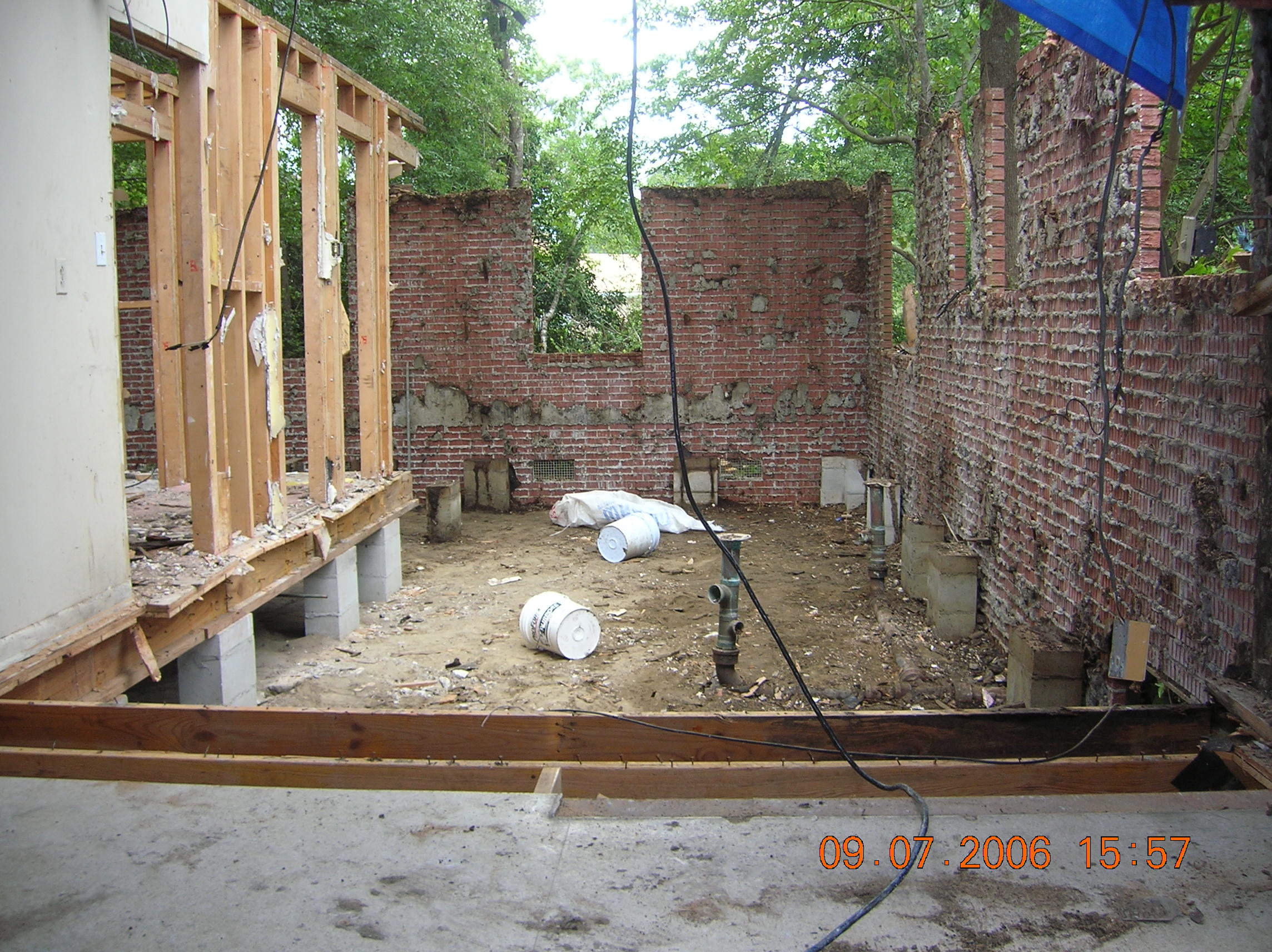
        The foundation and the brick façade of the Hurricane House were sound. Half the roof sheathing was fine, as well as half the structural framing. The sewer line to the street was good to go, plus the site had a beautiful grand live oak tree, a towering magnolia, and some antique camellias that survived the demolition/clean up phase. There was a lot going for this property before I even started, but it looked awful because Hurricane Hugo had torn it up.


Inside the Hurricane House
after the demolition phase:
a lot of good to work with.

                        The head inspector’s negative estimation could have doomed the Hurricane House to a date with a bulldozer and a trip to the landfill. Yet, in a quirky way this vocalized hopelessness became a blessing that echoed in my head throughout this project, energizing me until I received my Certificate of Occupancy and beyond. And when I closed out the project, the Hurricane House was the biggest profit margin of any of my houses thus far. 

I’m not saying the Hurricane House was an easy project. I don’t think I’ve had a simple rehab yet, so I’m not sure what that looks like. It was a good challenge, and I had a team of talented contractors helping me get it done. But my point is this; the positive attitude that began with that library book made it possible. I don't think I would have made it through college, moved to South Carolina, gotten my General Contractors License, or defied that building official without knowing everything I learned from Dr. Peale.

Maybe you want to be a home renovator and lack the confidence to take the next step. Or perhaps you're renovating a home right now and are at that stage in the middle where you feel like you’re never going to finish. Besides telling you these are normal feelings, I’d like to recommend that you go to your local library and borrow The Power of Positive Thinking. It just might change your life, too.

Monday, October 12, 2020

How the House in the Woods became Annie Leila's

     My projects have received names. With each one, the identifying moniker happened naturally. My first pig's ear had been devastated by a dryer fire that grew out of control. When folks would ask me about that project, they'd call it things like, "That house you did that was condemned after the fire." So it became "the Fire House." In 2004, I bought another home that building officials had declared uninhabitable. This rotting place was a victim of Hurricane Hugo that slammed into South Carolina in 1989, and it became my "Hurricane House." With each project came similar stories. Another example is the Country Victorian I bought in 2013 that was in American Rehab Charleston. It was, "The house you fixed up on TV," or the "TV House," until I did Restoring Charleston, and then it became the "American Rehab House." 

    In 2016, I needed three more houses for television. Along with the Appleby House, I bought a nine acre property on the other side of St. George with two houses: a bridal cabin that producers named the "Lowcountry Cottage" and the home which I called "the House in the Woods." Schedule and budget demands forced us to pull one home from our plans, so when we wrapped up our filming in August, I was left with my current project house shown in the pictures above. It was back off the main street in town and so engulfed by trees, bushes, and vines that many local residents didn't realize there was a home back in there. 

    The county library has a book that documents all the historic houses in area. In this book, the house is tagged as the "Whetsell House," but when neighbors mention the old home, they regularly call it "Annie Leila's House" or more simply "Annie Leila's," a reference to Annie Leila Whetsell, the previous owner who had lived in the house for most of their lives. 

    Annie Leila is a very pretty name. I've never known anyone named Leila and certainly no one named Annie Leila. I liked the name, The House in the Woods, but I like Annie Leila's much more. She called it home for decades and surrounded it with beautiful plants that I now enjoy. The neighborhood is still full of people that Annie Leila called friends and loved like family. So naming the property after her just feels right... and sounds a lot better than "Trent's." :)

Saturday, March 28, 2015

The TV House


My projects have names.  For people familiar with this part of the state, I can refer to a house by a town, neighborhood, or street and they'll know which pig’s ear I’m talking about.  However, with people from somewhere else, nicknames have emerged.   

I bought The Fire House after it was condemned by the local code enforcement officers.  The Cottage got it’s name when my realtor called it that in the sales listing.  The Hurricane House was severely torn up when Hugo rocked the state’s coast in 1989 and it was condemned by building officials 16 years after the storm.  The Bungalow got it’s nickname by another realtor in her listing and I liked how it sounded even though I'd never thought of this house in that way.   

The TV House
(aka The Country Victorian)

My current project is an old country house with some hard to miss Victorian features, so I quickly tagged it The Country Victorian.  But then… we got on television together and people have started calling it The TV House.  We’re something of a team.  She’s the star and I’m the supporting cast member.  Was she a diamond in the rough?  I wouldn’t say so.  I knew she was pretty special from the start.  She’s a one-of-a-kind, like all my projects have been, but I believe that she will be the one people will remember.  She’s the oldest, had the most issues, and is the one folks will always want to talk about because she got me noticed in a big way.  However, she’s tied to the other pig’s ears because without them, I wouldn’t have been ready to make an offer when I walked in the front door.

This TV House is like The Fire House because they both survived a fire.  She’s like The Cottage because of the way both original structures were added onto by previous owners.  She’s a little like The Hurricane House because the roof leaked in both and I had mold issues that had to be addressed, not a big issue to me, but to some, it’s scary and oftentimes a deal breaker.  The TV House is also like The Bungalow since they both had severe floor system issues that required total demolition down to the dirt crawl space below.  So in those ways, as I was renovating my previous projects, I was practicing.
 
I've immersed myself in all these rehabs in comparable ways.   I loved buying them when no one else wanted to.  I loved cleaning them up and understanding how they were put together.  I loved taking my pictures and sketching up various options on paper.  I loved digging in, working early in the morning, late at night, and through the weekends.  It was fun, but I was unknowingly getting ready for The TV House; my biggest and most challenging project yet.  It was another seemingly impossible project.  A property that others didn't want to take a chance on.  A house some were ready to tear down and send to the landfill.  But like my other renovations, The TV House was too good to demolish, too unique and special.  With the help of so many people, too numerous to list, she's going to be a star.  Summerville, South Carolina is a special town, full of so many grand historic homes.  The TV House has become something here.  People make a point to come find her and see what she looks like in person.  They're excited about her.  They take pictures and video.  I hope this appreciation continues long after the work is done.

Saturday, November 3, 2012

After Hurricane Sandy, Rebuilders Take Notice

I have thoughts regarding Hurricane Sandy and the rebuilding efforts that were seemingly underway before the storm had run its course.
I love building and rebuilding, but folks need to keep some things in mind before they head down the road of replacing what was lost and I'm talking to local leaders and taxpayers as well as home owners or potential rehabbers.
It will cost more in every way to replace what was destroyed by the storm.  I’m not merely talking about inflation and the fact that a 2x4x8 bought in 2012 will be more than one purchased decades ago, I’m speaking of building standards.  Hurricanes have taught us a great deal about the power of these storms and with the awareness that they seem to be getting more severe, those standards are only going to become more stringent.  And, stricter building codes will mean higher costs.  Someone rebuilding or extensively renovating after Hurricane Sandy will need to be mindful of this from the start.
Hurricane Clip
When we renovate a home we leave it better than when it was built 30, 50, or 70 years ago.  This is not just a professional standard that we set for ourselves; this is what’s required from the building industry, local building officials, and/or the insurance industry.  For example, we install Hurricane Clips where the roof structure meets the walls and install metal strapping at exterior wall openings and where the foundation meets the carpentry.  For us, this change happened as a result of Hurricanes Andrew and Hugo.    
This is the way things will be rebuilt on the East Coast in the wake of Hurricane Sandy.  They won’t be the same, they will be better.  It will make the beach homes and cottages cost more to replace because the storms are getting stronger and we know how to design, engineer, and build them better from the start.  There’s no sense in building something that’s going to blow away next year or in the next storm. 
Hurricane Strapping to tie Foundation into Wood Framing
In addition to this, the homes that survived and the homes that will be rebuilt will cost more to insure.  We live in the Carolinas, many states away from the wrath of Hurricane Katrina, but after that disaster our home insurance rates went up noticeably and the insurance companies explained that the increase was due in part to our county being considered as part of the coastal region.  We didn’t like it, but we took it on the chin and rationalized that its part of the price we pay for being less than an hour from the beach.  However, we don’t live on the beach and it some ways it rubs us the wrong way because we must have home insurance... so what are you going to do, but write the check and mail it in.   
As I've already said, I get pretty jazzed up about every part of new construction and renovations, but as the Post-Sandy rebuilding efforts commence, the unanticipated costs need to be considered now, not later.
See The Hurricane House  (Jan. 3, 2012)

Tuesday, January 3, 2012

The Hurricane House

Hurricane Hugo hit the South Carolina coast on September 21, 1989.  The storm slammed into Isle of Palms northeast of Charleston before progressing northwest into the inland counties of the Carolinas.  The home shown below was in Berkeley County.  The owners covered the roof with a tarp, but the damage was never repaired and it was condemned in the Fall of 2005 by local building officials.

The Hurricane House - Before
The Hurricane House - After

The tree that had done the most damage was still in the yard when I bought The Hurricane House in 2006.  The oak had been cut into segments with a chain saw, but had never been hauled away.  This exemplified what I started with.  It wasn't as if the property had been frozen in time for 16 years, but it was obvious that everything had changed with Hugo before Mother Nature and time tag-teamed the brick ranch to a deteriorated condition that many believed was beyond repair.  
 

The building official who had condemned the property told me emphatically that it could not be saved.  I had contemplated taking the house down and replacing it with a new home, but when I heard this negative prediction one thought instantly sprang to life in my mind; Now it's on.  His arrogant pessimism really stirred me up and I was determined to save The Hurricane House and prove that guy wrong.  Although the property had a long list of issues, I knew there were options to deal with them other than complete demolition.  The town rep. had not been on the roof and hadn't crawled under the home to examine the structural integrity of the framing.  Perhaps he'd never renovated a condemned home before.  I had and I was confident I could resurrect this Pig's Ear.     

When I bought The Hurricane House, it was the worst property in the neighborhood.  When I finished it in 2008, it was certainly worthy of being called a Silk Purse.      

Living Room looking into Kitchen - During
Living Room looking into Kitchen - After