Showing posts with label Condemned Houses. Show all posts

Wednesday, March 2, 2022

How To Get a Television Show

    People occasionally ask me for advice on how they can get on television, and with that comes curiosity about who I knew to get the cameras to come film me in action. Was it a relative? A family friend? Co-worker from the past? Former school or teammate? Was it an ex-girlfriend? The truth is, I had no previous connections or contacts in the TV industry.    

    The question about getting on television is common, yet I still don't have a super great answer or a recommended path. Oftentimes, I say: "Put yourself out there." The internet has made this easy, with plenty of ways to establish a platform to share your talent, wisdom, and passion. Think about what you're good at, and if it's something you love, then you're off to a good start. Next, pick a way to let others know about you. Writing is a great way to start, even if it's a few words or sentences to accompany a picture. People need to see your happy, smiling face, but elaborating with words will help them get to know you. Plus, writing is an excellent way to find your voice before you press the record button for a podcast or video.

    I started fixing up my first condemned home before house flipping shows were popular. Then people started asking me, "Are you a house flipper?" Many were excited to be meeting a real-life rehabber in person. Sometimes someone would say, "You should be on television." Home rehabbing is a dirty, tiresome process, so it was always nice to have some stranger drop in and say, "You should have your own TV show!"

    Eventually, I just grabbed the yellow pages, called the Home Rehab Dept. at Scripps Networks, told them a little about myself, and they sent out a crew the following week to get started with American Rehab Charleston... just kidding. You have to put yourself out there so the TV folks can find you. Can you go to them? I guess, but I don't know how that approach works. 

    Besides saving these houses that have been called pig's ears, I really enjoy writing. Starting this blog was a way to combine two things I really love. Besides the flipping questions and TV remarks, visitors would also often ask about how I turned my pig's ears into silk purses. "How do you do it?" they'd ask. "How do you save a house that's been condemned?" Blood, Sweat, and Pig's Ears became my way of teaching, sharing what I had learned while encouraging others to take on houses with potential, too good for the landfill. 

    However, I should say a bit more regarding my motivation to 'put myself out there." I've wanted to be an author for a good while. I'm already a writer, but I have a dream of being published. I had hoped that this blog might help me connect with a publisher or literary agent. Instead, it caught the eye of a television producer. So, as they say, while aiming for the stars, I hit the moon. I wanted to be in the bookstore but accidentally ended up on TV. 

    Finally, along with establishing a platform for exposure about you and something that's a major part of your life, make an effort to be positive while you do it. Trust me. This will open things up and allow you to be more productive. I have a tendency toward pessimism myself, so I'm mindful of this pitfall. Hope and optimism will get you where you're trying to go a lot faster than the alternatives.

    Good luck, and don't hesitate to circle back and let me know where to find you online... or on TV!    


Trent Fasnacht

bloodsweatandpigsears@hotmail.com


Wednesday, January 27, 2021

Snowman on Miami Beach

            
            I still had plenty to learn when I left home after high school and the world began roughing me up before I even unpacked my suitcase. I was dragging bottom by age twenty, with the confidence of a snowman on Miami Beach when I visited the Cincinnati Public Library and checked out the book, The Power of Positive Thinking. The cover of this edition said, "Read this book and change your life," and this sentence would ring true for me as I became a young man capable of surviving in the Queen City.  
                        
            My struggles with pessimism and negative thoughts still haunt me, but three decades later I’m acutely aware of how profoundly Dr. Norman Vincent Peale’s most popular book impacted my life and my career renovating houses, which I lovingly call ‘pig’s ears.’

We all know the classic example of a positive mindset: seeing a glass as half-full instead of half-empty. This attitude has become such a part of my life that I apply it to everything, most especially my project houses. I’m not sure how I could do what I do without this steadfast optimism.

My third pig’s ear was a home I call the Hurricane House. It was severely damaged by Hurricane Hugo in 1989 and its owners sold it to me for the value of the land in 2006. Soon after the closing, I walked the property with the head of the building department and said, “It's really not that bad,” since my approach to saving a condemned house focuses on what’s good and what’s salvageable. My ability to focus on real estate assets and past liabilities is the most significant quality I honed and cultivated from Dr. Peale's book.

However, as I finished my optimistic property appraisal, the building department chief, without much hesitation, said: “This house has to be torn down.” Clearly, he was looking at the all the damage and rot that dominated the Hurricane House. He was looking at the building as half bad or 50% rotten, while I was looking at it as half redeemable. After he said that a thought bolted into my head; “Oh. Now it’s on.” At this stage of my career, I was a confident freelance home renovator, verging on cocky, and his pessimism was the nudge I needed to get ready to grind. In addition, I had enjoyed enough success with my own projects that I had money in my savings to finance this one without a mortgage from the bank. The only person who needed convinced that this was a viable effort was me, and I was certain it was a winner. 

The roof of 
The Hurricane House
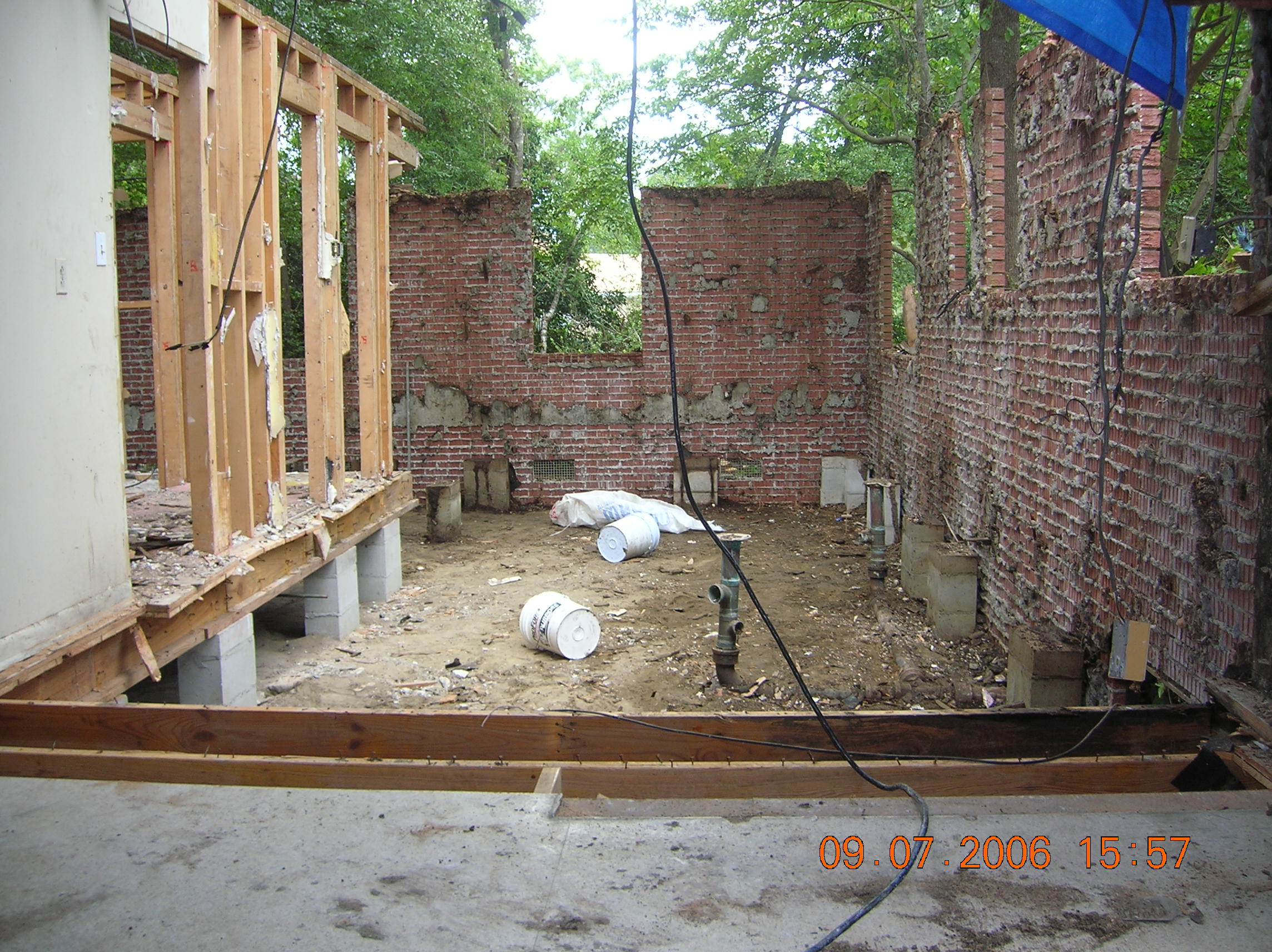
        The foundation and the brick façade of the Hurricane House were sound. Half the roof sheathing was fine, as well as half the structural framing. The sewer line to the street was good to go, plus the site had a beautiful grand live oak tree, a towering magnolia, and some antique camellias that survived the demolition/clean up phase. There was a lot going for this property before I even started, but it looked awful because Hurricane Hugo had torn it up.


Inside the Hurricane House
after the demolition phase:
a lot of good to work with.

                        The head inspector’s negative estimation could have doomed the Hurricane House to a date with a bulldozer and a trip to the landfill. Yet, in a quirky way this vocalized hopelessness became a blessing that echoed in my head throughout this project, energizing me until I received my Certificate of Occupancy and beyond. And when I closed out the project, the Hurricane House was the biggest profit margin of any of my houses thus far. 

I’m not saying the Hurricane House was an easy project. I don’t think I’ve had a simple rehab yet, so I’m not sure what that looks like. It was a good challenge, and I had a team of talented contractors helping me get it done. But my point is this; the positive attitude that began with that library book made it possible. I don't think I would have made it through college, moved to South Carolina, gotten my General Contractors License, or defied that building official without knowing everything I learned from Dr. Peale.

Maybe you want to be a home renovator and lack the confidence to take the next step. Or perhaps you're renovating a home right now and are at that stage in the middle where you feel like you’re never going to finish. Besides telling you these are normal feelings, I’d like to recommend that you go to your local library and borrow The Power of Positive Thinking. It just might change your life, too.

Monday, April 14, 2014

What Is A Pig's Ear?

        In Great Britain, pig’s ear is slang for beer, and they a have long-running celebration in London called the Pig’s Ear Beer Festival. Pig’s ear is also what the Brits call a major screw up. However, most dog owners think of a pig’s ear as a dog treat that they can pick up at the pet store.

When it comes to houses, and in particular my type of projects, a pig’s ear is a home that’s in terrible shape. It's a property that’s way over due to be rehabbed or it really needs saved.

       As a project house, a pig’s ear is more challenging than a fixer-upper and a lot worse off than a “handyman-special.” This type of run-down property is oftentimes the worst house on the block, but it might also be the ugliest property in the neighborhood or in town and may even have been condemned by building officials if they determine it to be uninhabitable or “too dangerous for human occupation.”  

       Folks who know me understand that the properties I take on are in this pig's ear category, and in most cases, no one else wanted to own or buy them. Investors, flippers, real estate agents, and other contractors have kicked the tires and said, “Uh… no thanks. I’ll pass.”

On a side note, I played rugby at the University of Cincinnati. If you’ve ever watched a few minutes of this wild sport, you understand how violent it is. There were plenty of times when people would comment on me playing and point out how brutal rugby can get. I’d usually responded with something like, “It looks worse than it is.” Resurrecting a condemned or abandoned home is comparable. For me, these pig’s ears have all looked worse than they were once I dug in and got to work transforming them into silk purses.

If a pig’s ear is a home left for dead, then I’ve been in the resurrection business for twenty-five years.

And finally, as a subsequent acronym, pig’s ear can stand for property in gnarly shape eagerly awaiting rehabilitation.

Thursday, December 8, 2011

Blood and Sweat

I had a childhood career of play that ended up being a good foundation to the fundamentals of building. During this playtime I learned how to put things together to make something better, which was also a good introduction to the art and science of construction.
As a little boy, I spent hours digging in the sandbox. I had a nice collection of miniature cars, trucks, and farm vehicles. I also had multi-colored plastic animals that had been collected from the bottom of the breakfast cereal boxes. I would build roads, mountains, and houses in the sand and form up walls to keep the animals corralled. I’d also break asbestos shingles off the side of the barn that I could use to make roofs and bridges in the sand. Using these shingles may be the first example of me making the most of whatever materials I had to work with.
During cold weather months I’d build inside with blocks, with Captain Kangaroo on the TV keeping me company. I fell in love with Legos, but also had fun building with Lincoln Logs, metal erector sets, and one of Kenner’s Girder and Panel building kits. I really loved playing baseball and collected baseball cards, using these cards to build too.
After I outgrew the sandbox, the kids in my family would make hay forts in our barn lofts and I built wooden platforms in the trees of the backyard, safe enough for me and a half dozen other kids.
Then I paid for college with blood and sweat on construction jobs. I have scars on my hands, arms, and legs from rebar that sliced my skin like razor blades, and more than once I stopped the bleeding with fast food napkins and duct tape from the job truck before I rejoined my crew when a concrete truck was on the way.  
I also have plenty of scars from playing. Besides baseball, I loved all the sports I discovered, but a dodgeball story is a good example of how I inadvertently mixed blood and sweat to get people’s attention. It was Junior High Phys. Ed. class and we took our dodgeball seriously. In one game, I caught the red ball before slamming my head into the corner of the brick gymnasium wall. The blood and sweat mixed together, making the injury look even more serious. In the end, a faculty member had to get me to the emergency room for a few stiches, but my head wound wasn’t as bad as it had initially appeared to my classmates, teachers, and the staff in the school office.      
Like that watered-down gash, my project houses have often appeared to be worse than they actually were. They have all been in pretty rotten shape, but they haven’t been landfill-worthy like so many people have warned.
I’ve always taken a real hands-on approach to my projects. This has been critical in my career because it helps me understand how the houses have been built and what needs to happen to put them back together the way I picture them in my scarred head. There’s been a lot of blood and sweat, and rehabbing has led to more scars and trips to the ER. But after twenty years, I’m still standing, and hammering, and without my own blood and sweat, it just wouldn’t be the same.

Rewritten December 14, 2019