
We all know the classic example of a positive mindset: seeing a glass as half-full instead of half-empty. This attitude has become such a part of my life that I apply it to everything, most especially my project houses. I’m not sure how I could do what I do without this steadfast optimism.

My third pig’s ear was a home I
call the Hurricane House. It was severely damaged by Hurricane Hugo in 1989 and
its owners sold it to me for the value of the land in 2006. Soon after the
closing, I walked the property with the head of the building department and said,
“It's really not that bad,” since my approach to saving a condemned house
focuses on what’s good and what’s salvageable. My ability to focus on real
estate assets and past liabilities is the most significant quality I honed and
cultivated from Dr. Peale's book.
However, as I finished my optimistic property appraisal, the building department chief, without much hesitation, said: “This house has to be torn down.” Clearly, he was looking at the all the damage and rot that dominated the Hurricane House. He was looking at the building as half bad or 50% rotten, while I was looking at it as half redeemable. After he said that a thought bolted into my head; “Oh. Now it’s on.” At this stage of my career, I was a confident freelance home renovator, verging on cocky, and his pessimism was the nudge I needed to get ready to grind. In addition, I had enjoyed enough success with my own projects that I had money in my savings to finance this one without a mortgage from the bank. The only person who needed convinced that this was a viable effort was me, and I was certain it was a winner.
The foundation and the brick façade
of the Hurricane House were sound. Half the roof sheathing was fine, as well as
half the structural framing. The sewer line to the street was good to go, plus
the site had a beautiful grand live oak tree, a towering magnolia, and some
antique camellias that survived the demolition/clean up phase. There was a lot
going for this property before I even started, but it looked awful because Hurricane
Hugo had torn it up.
The roof of
The Hurricane House
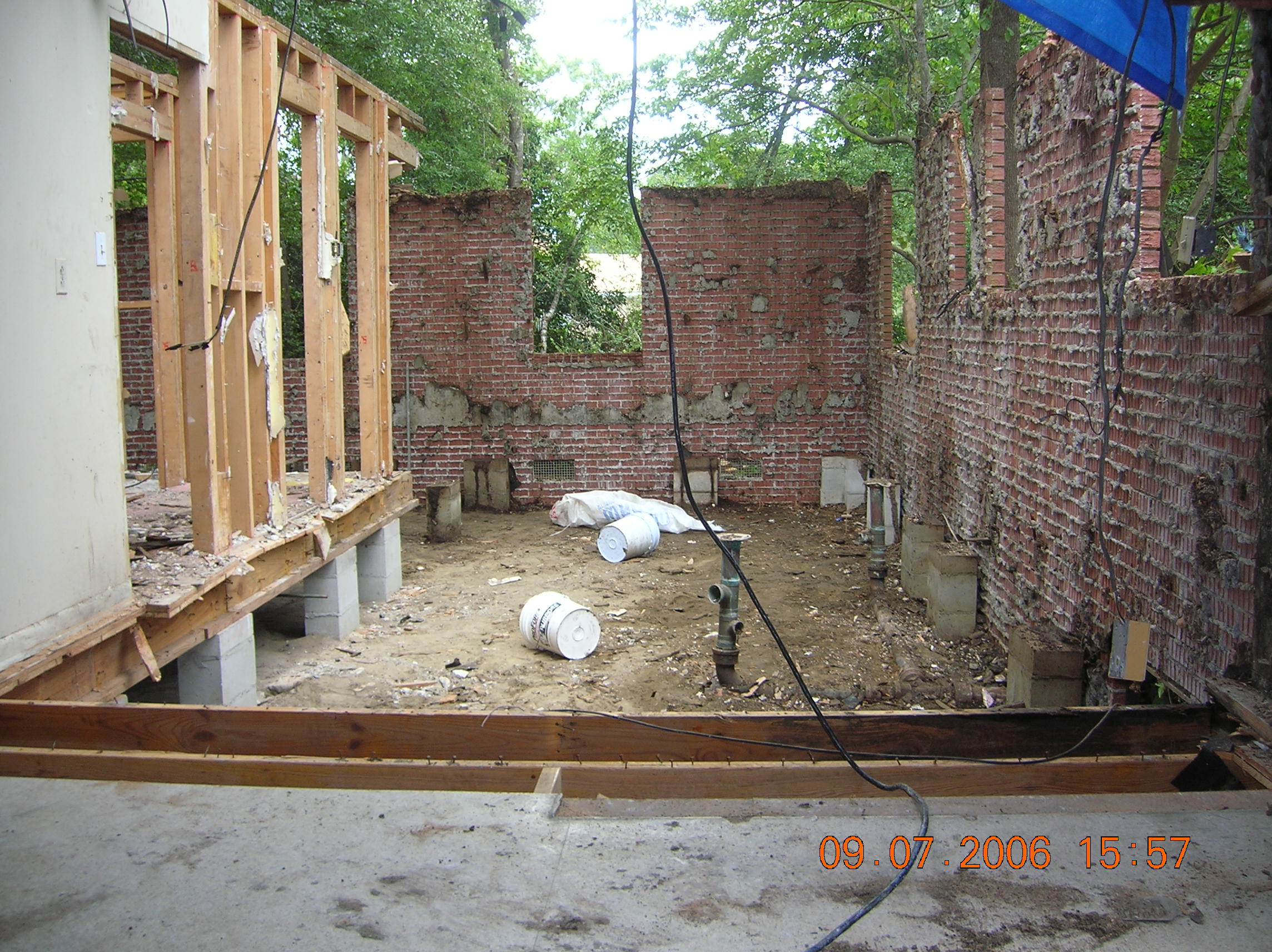 |
| Inside the Hurricane House after the demolition phase: a lot of good to work with. |
The head inspector’s negative estimation could have doomed the Hurricane House to a date with a bulldozer and a trip to the landfill. Yet, in a quirky way this vocalized hopelessness became a blessing that echoed in my head throughout this project, energizing me until I received my Certificate of Occupancy and beyond. And when I closed out the project, the Hurricane House was the biggest profit margin of any of my houses thus far.
I’m not saying the Hurricane House was an easy project. I don’t think I’ve had a simple rehab yet, so I’m not sure what that looks like. It was a good challenge, and I had a team of talented contractors helping me get it done. But my point is this; the positive attitude that began with that library book made it possible. I don't think I would have made it through college, moved to South Carolina, gotten my General Contractors License, or defied that building official without knowing everything I learned from Dr. Peale.
Maybe you want to be a home renovator and lack the confidence to take the next step. Or perhaps you're renovating a home right now and are at that stage in the middle where you feel like you’re never going to finish. Besides telling you these are normal feelings, I’d like to recommend that you go to your local library and borrow The Power of Positive Thinking. It just might change your life, too.


