Monday, July 27, 2026

Grinding or Raking Weeping Mortar Joints

Embracing Weeping Mortar - July 13, 2026

Moving Beyond Weeping Mortar - July 20, 2026

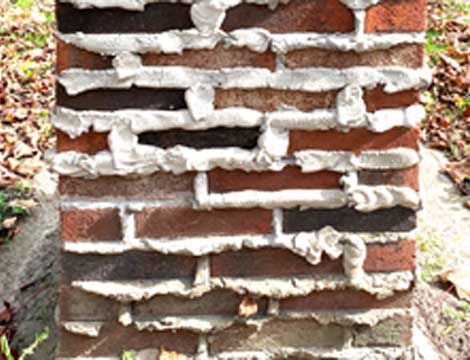
As written previously, the first house I ever bought to renovate was a property with weeping mortar joints. And what made this more of an issue to the look of this home was that the brick façade had been painted.

Weeping mortar
Pig's Ear #1 - back side 
There were many challenges I was ill-prepared for, both as a new homeowner and also in my role as first-time rehabber. Two biggies were the flood of discouraging comments from uninvited visitors. And the second was the fraternal twin: unsolicited advice. In most cases people were unwittingly thinking aloud. But I didn’t need hecklers making me aware of how this place would require much
more than a little TLC. There’d been a bright red tag on the door saying CONDEMNED – Unsafe for Human Occupation that had delivered that message from moment one.

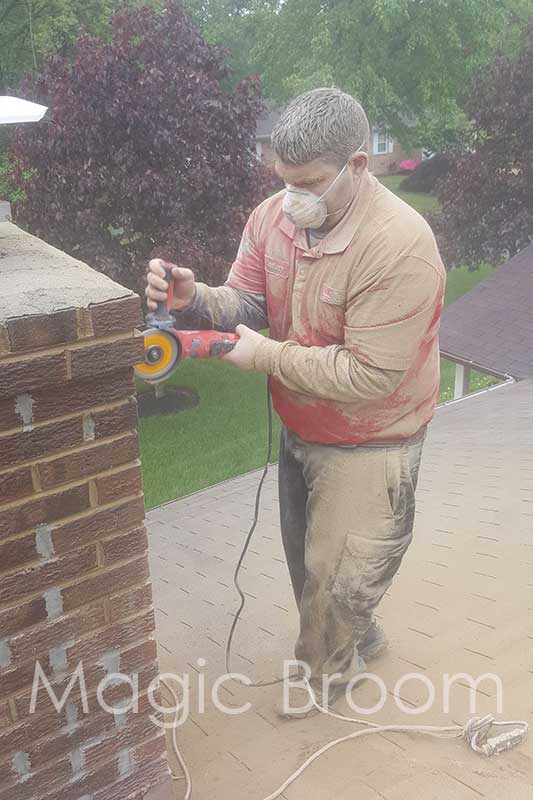
During one of these visits, when I was immersed within the mix of work I faced, combined with the potential I saw in my mind’s eye, one chatty gray beard peppered me with how he thought I should deal with the solidified ooze framing each brick in my exterior walls. “What you need to do,” he said, “Is go down to the rental house and rent something to grind it off.”

Although I listened politely, I was less than stoked about this as a possible item being added to my growing to-do list. Yet still, I wondered if I was being hasty and mulled the idea over in my head for a few days.

And now, I want to explain why that recommendation may be the ideal solution for others, but for me it’s still in a mental file in my noggin that’s labeled No Bueno.

Perhaps I’ve accumulated more experience with the sort of equipment required to grind or rake these sorts of joints. It might just be that this man was unfamiliar with the rabbit hole/can-of-worms scenario he was proposing for me. And that’s what it would have been. Again, this is just for me. For someone else this might be a Jim Dandy solution to weeping mortar.

If I’ll get my money’s worth out of a tool, I’ll buy it. Otherwise, I am always grateful when I’m able to rent equipment. And if it’s something I’ll need for more than a day, and it’s possible, I’ll plan it out for a weekend since there is oftentimes no charge to have it on Sunday. It’s kind of a buy one, get one hack. And no one appreciates the BOGOs more than this guy.

So, if I rented some sort of grinding tool, I’d have been determined to max out my usage, getting the most out of the rental. I’d have planned on jumping on this grinding work to bang it out until I was either finished or forced to wrap at a stopping spot on Sunday. And this was why using a grinder didn’t seem like a solution for me, since it’s labor-intensive work, and I suspected slow going. I knew that after a few hours, my energy gauge would have been buried on E. And you don’t want to operate a tool like that when you’re out of gas. It’s dangerous and can get away from you quickly. And in my case, a loss of control would mean damaging my bricks. Plus, being cautiously practical, I suspected that I’d have been dissatisfied with my amount of progress. It wasn’t negativity over someone else’s idea. It was experience chirping in my brain.

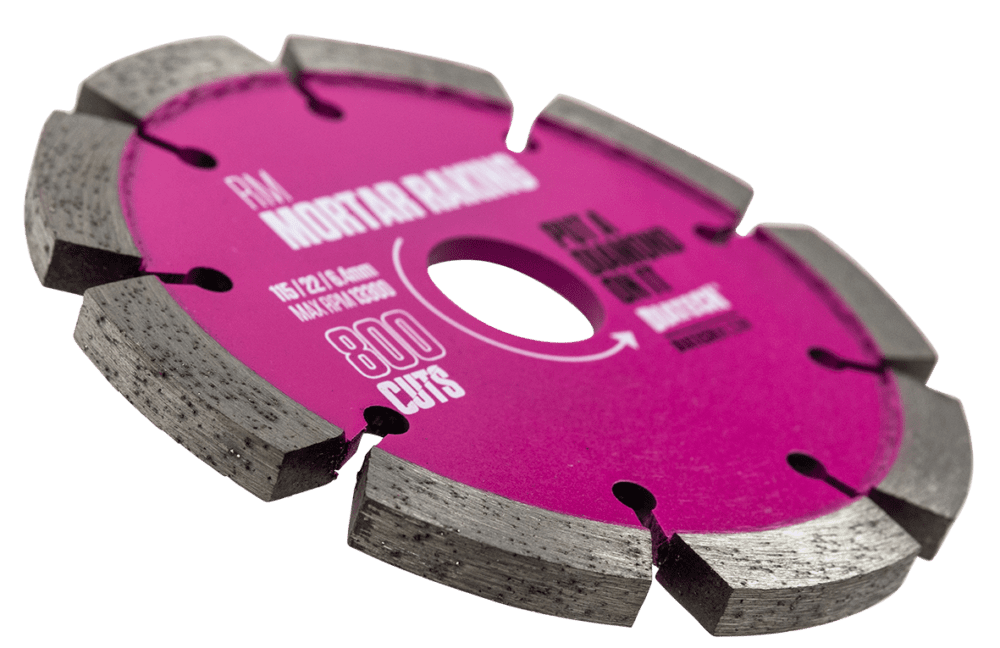
Rake bits
for vertical joints
Rake Blade
In order to rake the joints of an eighteen square foot home, I would have needed a crew, and maybe multiple grinders and the ready supply of blades and bits to maintain momentum while the clock ticked. In 2000, I was new to Coastal South Carolina. I didn’t have folks to lend me tools, and I had no friends, family, buds, or former teammates to pitch in and help. I was a one-man team and raking the lengths of my WMJs was a job best suited for a squad. And no matter how I tried to plan it out, the bottom-line kept coming out intimidatingly pricey, even when I used super conservative guesstimates.

I should have been more appreciative of the suggestion, since it ultimately forced me to think it all out and then arrive at the right course of action for me on this project house, which was Chipping Off Weeping Mortar (coming soon).

Monday, July 20, 2026

Moving Beyond Weeping Mortar

I know what it’s like to own a home with weeping mortar joints. Furthermore, I get how it feels to have neighbors and visitors who are less than enthusiastic about this look. Not only can this sort of façade be polarizing, but time can also make it an issue homeowners feel compelled to address, especially after hearing people groan, say, “Ew! Yuck!”, or even ask with genuine sincerity, “What do you think they were trying to do here?” as they stare at your solidified ooze.

In my previous post I explained how someone might consider Embracing Weeping Mortar. But here, I’ll introduce two other options.

I suspect that the group of renovators who can say, “I want to grind out or chip off all the joints of my brick house!” is a small club. And it would be wonderful to imagine the possibility of waving a magic wand and having your sloppy joints disappear. But real-life solutions beyond sorcery do exist.  

Let’s say that you’re like I was, finding yourself in a situation where you feel as if you absolutely must deal with a weeping mortar situation. Besides mine—a painted brick house where the uniqueness of this style has been eclipsed—I can think of another circumstance that would make this condition tougher to ignore much of these joints being damaged badly.

Perhaps over time, a multitude of chunks have been victimized by Mother Nature and her weaponized freezing and thawing. Or maybe someone started yanking off invasive vines, and in doing so they accidentally broke off large sections of the weeping mortar.

What now?

If these joints have been damaged, I supposed there are ways to repair or make these no-longer-uniform spots less noticeable. However, if the area(s) of concern is/are widespread, other measures may be taken. For one, grinding out the joints and replacing them with fresh mortar is one possibility. Or as I did, you can chip them off.

Certainly, I suppose there are ways of patching and repairing the damage. But there are two huge issues with this. First off: cost effectiveness. And secondly, a big question: Will the repair work end up being more noticeable that the damage looked before mitigation or corrective measures were taken? I believe this is highly likely.

Because of these practical considerations, I will go on to explore two other options in detail.

Grinding or Raking Weeping Mortar Joints – July 26, 2026

Chipping Off Weeping Mortar – Coming Soon

Monday, July 13, 2026

Embracing Weeping Mortar

The first home I ever bought and renovated had weeping mortar. And these joints were critical to my opportunity to buy this house because it made the home look unsightly. I believe they scared other potential buyers off, not because this style is distasteful, but because the brick ranch had been painted and it made the property uglier and seem more hopeless, or more of a daunting challenge, than it would have otherwise. 

Painted weeping mortar of Pig's Ear #1 

Over time, a theory formed on my part that previous owners had ultimately decided to paint the façade after a master suite was added. Matching brick can prove to be trickier than one might imagine, and my deductive speculating has grown to presume that the old and new brick weren’t alike enough. In my Sherlock Holmes of renovation mysteries mind, the paint job established uniformity that resolved this elementary dilemma.  

This experience made me into a fan of weeping mortar, as long as it’s not been coated in paint. And since then, I can be cruising through some unfamiliar neighborhood, and this unique exterior coursework style will grab my attention. And I truly appreciate it for the aesthetic statement it makes.  

Although I am no bricklayer, I have laid a few pallets worth of brick and block over the years. And not only have I been the mason, I’ve also been the person buying materials and the tender mixing up the mortar. So first off, I am aware of the extra time and money it takes to pull off an entire house that showcases these oozing joints. And I can only imagine how much waste and extra clean up this adds to a project.

Still, when the work is finished and colors and textures contrast, it can be striking. And that’s the look that is easy to embrace.

My most favorite example of these joints is when they’re coupled with rust colored brick. And this may just be me, but I’ve really been taken in by homes with white windows and trim that add some visual pop along with well-manicured ivy that has been permitted to creep up to the soffit.

Like the lawn and hedges that need regular attention, these green leaves and vines must be kept in check. But I think it’s worth the commitment and effort, because for me this condition on the right home, when carried out effectively and properly, makes a memorable and quite fetching impression.   

If you have weeping mortar, I hope my take might allow you to appreciate it even more than you did.  However, if you are looking for options to divorce yourself from these sloppy joints, I’ll post about potential remedies in posts that follow.  

Moving Beyond Weeping Mortar - July 13, 2026

Monday, July 6, 2026

Final Post of the Series - Response to TV Show Viewers: Post 71

Response to TV Show Viewers: Post 1 - January 23, 2026

Response to TV Show Viewers: Post 70 - July 3, 2026

Apologies from me have been long overdue. So many worked hard on my behalf making American Rehab Charleston and then Restoring Charleston. I wanted to do better, to be better, and was far too short-sited on the ways things would play out. As I’ve mentioned, despite how I may have appeared within each series, I am aware than I was out of my depth in these circumstances, and for that I am sorry, for both myself and others. The most recent posts were intended to recognize efforts of the key construction protagonists who made me look capable and competent throughout ARC and RC, as I was actually struggling to keep my head above water for most of this experience.

On the production side, diligence on the part of producers gave me a shine that only they were capable of doing. For example, at times, it seems as if they often had me wearing blue to make my eyes grab attention, perhaps distracting from my asymmetrical mug. They kept me focused by scripting much of what they needed me to say, and this took a toll on all of us. Remaining patient with me throughout could not have been easy. The teams of people that had come to record me in action were used to working with pros, some trained, others naturally gifted. Although I showed up, put in time as asked, I was just unable to deliver on camera as they needed.

There were many times when I would say something in a filming, almost as producer’s would have liked, only to have an auditory hiccup make what I’d said unacceptable. Maybe some people can just rewind and say what they’d just said over again verbatim. But I never got there. At least not as easily as most would have liked and my efforts led to a stuttering issue, something that I’d never had to deal with before. I’m not sure how this Porky Piggishness works. Maybe it was my brain and mouth in some sort of conflict over pressurized calls to speak with so many listening. I had bright moments, but the skips in speech increased over time. This oratory accessory was not permanent though, and eventually faded away sometime before the pandemic, as casually as it had waltzed in.

I’m mentioning this as a lead in to talking about my appreciation for the show producers. I still don’t hold much confidence in the dos and don’ts of the television industry. I felt like I did a lot more incorrect than I did right in working with them and I continue to be uncertain of many things, off camera and on. I do candidly have serious concerns that more than a few might see my doing this—mentioning names without role/contribution precision—as further examples of my flaws and unworthiness. However overblown this may be in my head, I am using it as an explanation for not mentioning the champions on the production side by name.

Enough of the pity party though.


Within my dive into TV, I felt the red-hot desire to hit home runs on camera for the teams around me. And through this, opinions were naturally formed about addictions taking root for those desperately trying to deliver for people supporting and pouring into them. However, other than high doses of caffeine, I am able to report that I remained drug free for the duration and aftermath of this TV foray. And there are those you will see this position as one more issue.

Regarding my verbal fumbling and stumbling on camera, that was pureness. No cue cards or teleprompters were used in the making of either series, not by this guy or anyone else, never in the three years. Producers and I ground it out painfully together, from the pilot to the final day of RC. No shade cast toward newscasters, SNLers, or others. I’m envious, wondering if I could have even pulled off using those sorts of aids.

I worked with at least four different production companies. And I’m still foggy about who worked for which, those serving as independent contractors, members of the interior design teams vs. production, and on and on. I will say that of the things we really needed going into making Restoring Charleston in 2016, the one addressed was the experience of the production crew that the network executives were able to surround me with. In lieu of reality show backgrounds, we had producers more seasoned in home renovating. Maybe not condemned houses, but highly applicable knowledge and that was critical in us all working together to meet the tight schedule requirements.

As I touched on in a previous post, settling in down on the region’s historic peninsula for three months is a major expense for anyone. But along with this, was the cost of time and the extra wear and tear this choice placed on the production team. Without traffic, St. George is an hour from Charleston. But coming and going Monday through Friday, getting vehicles from parking garages, etc. and then dealing with rush hour traffic equated to nearly three hours of stressful commute adding in to each long workday.

It must have been thrilling to stay downtown. And crews were troopers about any supplemental burden this created. However, it couldn’t have been easy. And as I mentioned before, I should have suggested they stay somewhere closer. Easier scoots back and forth on I-95, like coastal situations on Lake Marion, would have done the trick. Then they could have escaped each weekend to the Holy City for R&R. Budget wise, this would have been best. But being candid, I was oblivious to much of this until afterwards. That’s on me and another thing I have regrets over.  

In 2016, my imagined adversarial presence with producers seemed to evaporate and I was included more into the circle of collaboration. This was not just helpful to me, but it made the summer more enjoyable, and in my view, it led to greater productivity. Over the course of three months, I learned to really appreciate while simultaneously trust the producers. These days working and filming throughout Berchador and I am unable to say enough hearty things about this crew I still feel blessed to have gotten to work with. I may be wrong, but I think they’re the blend of a team that could pick up next week where we left off a decade ago, the production/construction combo working together on opposite ends of St. George through triple digit heat.

With this appreciation for the teamwork and natural comradery we developed, I am also wholeheartedly grateful for several crucial producers who looked out for me. They advised and mentored me discreetly, pulling me aside as needed, whispering in my ears like veteran teammates or wise older siblings. I listened and it was life altering advice I’ll likely never be able to appropriately repay them for. In some perilous ways, these strangers who’d quickly grown into confidants and friends, also served as my guardians, saving my family from what I came to realize would have likely been devastating missteps on my part. Although I would like to mention these folks, as much or more than the contractors, they very specifically advised me that their anonymity was paramount for their own careers. I see this as cloak and dagger means and methods of thoughtfulness. So, for them in particular, I’m obliged to write of my nonspecific gratitude. You know who you are and I am forever appreciative beyond my words.  

Throughout this experience, I had perhaps been too overly focused on the boatloads of positives. Many can say I was naïve and too trusting. And yet I survived. We survived. And the shows are still out there getting attention. Could it have been better? Clearly, yes. But could it have been worse? Absolutely.      

I caught a shooting star in one hand and then was pulled and pushed out of the path of an erratic rolling boulder. And for both of these, I’ll always be indebted.

FINAL POST OF SERIES

Friday, July 3, 2026

Josh, Chris, and Jason - Response to TV Show Viewers: Post 70

Response to TV Show Viewers: Post 1 - January 23, 2026

Response to TV Show Viewers: Post 70 - July 1, 2026  

The end of this response series is leaning heavily into the fond memories of those who made it possible.

My three-year experience was broken into parts, clearly focused on the periods of taping the home rehabs for each TV series. The bulk of filming the pilot episode took two weeks in March 2014, the three months of what producers called the five-episode pick-up happened in the first quarter of 2015, and we made Restoring Charleston summer 2016 with any planning and post-production work happening in between.    

American Rehab Charleston - 2015

As I described in my previous post, Bob Fleming, the general contractor brought in to help us make the first episode of American Rehab Charleston, was the inadequately recognized hero who got us started on our way. Although there were many factors to us moving through each step of this experience, I don’t see how we could have gotten through March 2014 without Bob.

For the 2015 filming, the dynamic duo of Josh Hofbauer and Jason Dandridge were the miracle workers making me look masterful.

Jason Dandridge filming Restoring Charleston
Jason’s talents mirrored much of Bob Fleming’s in how he commanded his troops. In addition, I believe he may have membership in some legion of carpentry wizards, wowing me with his fractional math on the fly, in his head, factoring in multiple floor heights fluidly, considering thresholds and the materials and layers of multiple additions. I’ve done this, but not near as effortlessly, needing to double and triple check my figuring, while backtracking and scratching my head throughout. I’d never worked with someone as capable as Jason in these critical scenarios.  

He and Josh were an impactful combo and it was easy to take their teamwork for granted.

From the start, Josh reminded me of someone I’d known for years, and we quickly fell into step together on site and while being filmed. He was juggling the list of scopes in his head at once, the work I normally did. He handled it admirably, with added pressure of producers pushing the breakneck schedule. And to make it all even more difficult, he and the trades were forced to stop working throughout each day so I could stumble through multiple takes for the camera as they waited motionless and quiet out of view. I don’t know how Josh or any of them managed or how they truly felt. I imagine it would be like driving a car in heavy traffic while you’re trying to wolf down lunch, frequently being directed to pull off to the side, shutting down the engine, checking your phone, cranking back up, as you react to each whim and seemingly urgent need of a variety of production crew members.  
Josh Hofbauer

I think the majority of the guys were so proficient at their work, that they thrived on weaving their way through the extra wrinkles of the production schedules and activity. They plodded without big reactions, as if they privately knew the experience made them even better and gave them entertaining stories to tell down the line someday.

But speaking for them, they couldn’t have all been okay with me taking credit for what they did. No way. And I do understand that and am sorry I was unable to take more of a stand in this regard. Not only would it have been the best way to go, as I’ve said before, I think authentic appreciation on camera, intertwined into each episode, would have made both series better and more helpful for viewers trying to learn.   


By the time we started filming Restoring Charleston, Josh had returned to Michigan. But Jason lived with his family in the Upper Dorchester part of the county, and I was thankful he was willing to put off his other projects and focus on the Appleby House. With ARC under his belt, Jason had a solid sense of what the producers were doing and needed from him. He knew what he and his crew could do late at night, after everyone had gone home, and what must wait until regular hours when the producers and I had returned. The value of this aptitude is difficult to explain, but his experience in this regard had a sizable impact and the achievement of what many had told us was impossible: renovating both homes in nine weeks. Even more, he and his team did it with producers in the mix. A monumental accomplishment. This was not me. I was just a middle-aged cheerleader narrating his orchestration.  

Chris Brace
It was similar to Chris Brace remaking the cottage on the other side of town. And even though that house was smaller, this was a steeper mountain for the Brace Builders crew since they were rookies in TV rehabbing. To make this ride even wilder, they were an hour away from familiar territory and his shop. I’d only worked with Chris once before prior to this, in an easy role for me as a volunteer in his efforts transforming a house into a women/children’s shelter. Because of this tie, I knew what type of stellar work he did. And although I enjoyed working with Bob, Jason, and Josh, none of that fun was captured as effectively as the comradery producers found a way to feature with Chris and I getting down and dirty in episodes six through eight.

Like my feelings about Bob Fleming, it’s hard to imagine how I’d have gotten through this experience without the talents, skills, and efforts of Jason, Chris, and Josh.

Response to TV Show Viewers: Post 71 - July 3, 2026

Wednesday, July 1, 2026

Bob Fleming: Unsung Star of the Pilot - Response to TV Show Viewers: Post 69

Response to TV Show Viewers: Post 1 - January 23, 2026

Response to TV Show Viewers: Post 69

In the filming of American Rehab Charleston, producers needed a hero shot. I’m not a soldier or emergency person, so I had to be coached up by the showrunner who said, “You’re the hero here, Trent. You’re the one saving the house.” Restoring some property no one else seems to care about is hardly worthy of glorified status. But this person and their crew had been assigned to me and part of showing up required cooperation, a willingness on my part to go along with what they were trying to get done.

To be clear though, not only am I unheroic, but I also wasn’t even the driving force on these two weeks of work, certainly not like what I usually do on my projects. An executive producer was leading efforts to create the pilot, and this person had hired an amazing general contractor named Bob Fleming to oversee all the renovation activities over and around me. 

Bob Fleming
Classic Remodeling and Construction

It had all started with a programming director reaching out to me before I found, bought, and then redesign the home, I had dropped way down the list of truly significant. And on the surface, it looked like I was the guy. But below that, to anyone paying attention for a couple minutes, Bob was the true commander on my house project. And although I admired the depth of his experience, the respect his crews had for him, and the commitment he granted toward what was being done on the house I’d invested in, it didn’t feel great to be sidestepped.

With time, I could have done what he did for us. I wanted to. Except it would have taken me months. Producers only had two weeks, and he pulled it off seamlessly. As a compromise here, since they wanted and needed to bring in someone like Bob, I think it’d have been best for all if I’d just sung his praises on camera. Nothing over-the-top or grandiose, just honest acknowledgement that was deserving because Bob is a true contracting master, perhaps what I could have been, but heights I came up short in reaching.   

This use of the general contractor may shed some light on the differences between the production company and HGTV/DIY, something I’d unknowingly stepped into. And maybe the folks in New York thought I was hunky-dory on this circumstance. Again though, there’s so much I didn’t know about.

So even though I was the subject of focus for the hero shot in the intro and the series, the real Houdini of the pilot episode house project was Bob Fleming and Classic Remodeling and Construction

Response to TV Show Viewers: Post 70 - Coming Soon