Monday, August 17, 2026

Scaling Back on Blog Posts

I kicked off this year with the Response to TV Show Viewers series from January and into July, with those articles falling into a Monday-Wednesday-Friday pattern. Since then, I've posted on Mondays while considering how this blog will fit in with my other work and writing. 

Going way back, finding balance has been bumpy for me. And it was like this when I first started working for myself, and similar yet different after marriage and fatherhood, with me continuing to struggle to get a reasonable grip on some sensible, productive, healthy dynamic since. 

Trent Fasnacht

These last several years have created new challenges and a fresh search for equilibrium that feels right. Within this ongoing phase, I've developed renewed appreciation for Blood, Sweat, and Pig's Ears as my place to share writing and then direct people who reach out.

For now, I am going to scale back here and Substack in order to refocus on larger writing projects. I will begin posting on each at the beginning of the month, coupled with a commitment to maintain this approach into 2027. 

Until then, thank you, and have a great rest of your summer.     


Monday, August 10, 2026

7 Phases of a Home Rehab

Introduction – The process of finding the right project house is a prelude to rehabilitating it, and its own brand of fun.

1. Acclimation – Getting familiar with the property more deeply, including neighbors and surroundings.   

2. Reckoning – Understanding and accepting what you’re actually dealing with and how to take on the challenges.  

3. Bones and Deadwood – All the prep behind the sheetrock that should be buttoned up before rough-in begins.

4. Nerves and Tubes and Systems – Roughing in of plumbing, electrical, HVAC, and technical wiring may not be sexy, but it will make the house feel like a home when everything works as it should and is where it belongs down the road.

5. Glimpses – My favorite phase—insulation and drywall—when the house begins to look and feel as it was planned and imagined.

6. The Awakening – The finishing layers that will be seen, touched, and enjoyed begin to pop, sparkle, and shine room-by-room.

7. Home Stretch – Water is on, lights work, controlling room temps is seamless and it’s safe to bring in appliances, furniture, and window treatments.

Conclusion – For homeowning rehabbers, this is the honeymoon phase of the renovation. In the case of the flip, it’s bittersweet, a mixture of so many things that culminate in the final goodbye.

Monday, August 3, 2026

Chipping Off Weeping Mortar

Recapping briefly, my first pig's ear had weeping mortar. And what made it a larger issue in the eyes of many was that it had been painted, greatly impacting the impression of this bricklaying. This was my first exposure to this style of masonry, and I wasn't sure how to deal with it.

As I mentioned in a previous post, one visitor suggested I grind it all off, that I rake the joints. However, I knew this was more work than I wanted or needed to bite off. Since this house had been condemned, a livable situation that was a casualty of an out-of-control dryer fire, I had a long list of pressing scopes of work. And the clock was ticking since I’d agreed to a twelve-month timeline with my lender. Even if I could have connected with someone willing and able to carry out this task, it would have certainly wrecked my limited budget.

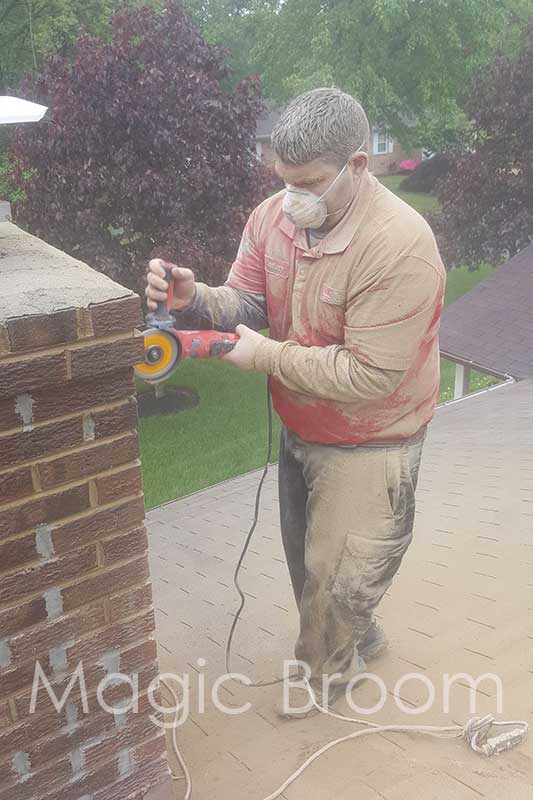
Raking the weepers myself wasn't an option. First off, flying solo grinding out joints that totaled nearly two miles would have worn me out. And I was hesitant about my ability to estimate the time (or pricey blades and bits) the grinding/raking approach would have required. Nearly everything about this option was unappealing. At this point in my career, I had years of construction experience but not much logged in residential work. Although I was curious, I knew in my heart (and gut) that starting down the raking path was a mistake. More than intimidated, I was certain I must avoid opening up what would be a huge can of worms.

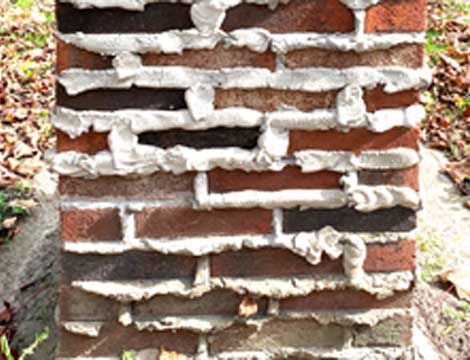
I had an issue that needed a solution and eventually landed on chipping off all the weeping mortar. The picture above shows approximately fifty square feet of joints or 250 lineal feet. If I tried to rake all these joints, besides the time and cost, I would have had to take precautions so I wasn't breathing in grit during the hours of work I would be taking on. And I'd be faced with pushing through unavoidable fatigue, battling the chance that the grinder might get away from me and either damage bricks, or jerk into the wooden shutters or the frieze board under the soffit.  

If you look at that picture again, keep in mind that I was dealing with this amount of chipping times a little over forty, greater than two thousand square feet. But as I mulled it over for several days, I became more comfortable with chipping it off as my best remedy.

Rather than jumping in, I decided to do a small sample area on the back side of the house, just to see how long it took and then ultimately looked. I did about two square feet in less than five minutes. Plus, I was surprised by how much I liked the textured joints this chipping created, and to me, it was better than the painted weeping mortar I currently had.

Two thousand square feet seemed immense until I arrived at my plan to break it all up into bite sized sections—twenty-five square feet at a time. I estimated that each would take around thirty minutes, adding up to about forty man hours. I built myself a 4’x8’ cubed scaffold to work the top half of the façade and fell into a daily groove. Then, I’d slide the box frame into place for the next day and move onto some other work on my list.

This no-power-tool approach wasn’t difficult, there was minimal dust, and I settled in on one five-by-five-foot area each evening after work, then double or tripled up on weekend days until it was all knocked out.

A month after starting, the end result was unique. I found it distinct and tasteful, contrasting with what I’d inherited at the closing. It felt like progress while the rest of the house was still looking pretty rough. And in a small town full of doubters, I began to win over a growing group of interested observers.

Links to recent posts on weeping mortar:

Embracing Weeping Mortar - July 13, 2026

Moving Beyond Weeping Mortar - July 20, 2026

Grinding or Raking Weeping Mortar Joints - July 26, 2026

Monday, July 27, 2026

Grinding or Raking Weeping Mortar Joints

Embracing Weeping Mortar - July 13, 2026

Moving Beyond Weeping Mortar - July 20, 2026

As written previously, the first house I ever bought to renovate was a property with weeping mortar joints. And what made this more of an issue to the look of this home was that the brick façade had been painted.

Weeping mortar
Pig's Ear #1 - back side 
There were many challenges I was ill-prepared for, both as a new homeowner and also in my role as first-time rehabber. Two biggies were the flood of discouraging comments from uninvited visitors. And the second was the fraternal twin: unsolicited advice. In most cases people were unwittingly thinking aloud. But I didn’t need hecklers making me aware of how this place would require much
more than a little TLC. There’d been a bright red tag on the door saying CONDEMNED – Unsafe for Human Occupation that had delivered that message from moment one.

During one of these visits, when I was immersed within the mix of work I faced, combined with the potential I saw in my mind’s eye, one chatty gray beard peppered me with how he thought I should deal with the solidified ooze framing each brick in my exterior walls. “What you need to do,” he said, “Is go down to the rental house and rent something to grind it off.”

Although I listened politely, I was less than stoked about this as a possible item being added to my growing to-do list. Yet still, I wondered if I was being hasty and mulled the idea over in my head for a few days.

And now, I want to explain why that recommendation may be the ideal solution for others, but for me it’s still in a mental file in my noggin that’s labeled No Bueno.

Perhaps I’ve accumulated more experience with the sort of equipment required to grind or rake these sorts of joints. It might just be that this man was unfamiliar with the rabbit hole/can-of-worms scenario he was proposing for me. And that’s what it would have been. Again, this is just for me. For someone else this might be a Jim Dandy solution to weeping mortar.

If I’ll get my money’s worth out of a tool, I’ll buy it. Otherwise, I am always grateful when I’m able to rent equipment. And if it’s something I’ll need for more than a day, and it’s possible, I’ll plan it out for a weekend since there is oftentimes no charge to have it on Sunday. It’s kind of a buy one, get one hack. And no one appreciates the BOGOs more than this guy.

So, if I rented some sort of grinding tool, I’d have been determined to max out my usage, getting the most out of the rental. I’d have planned on jumping on this grinding work to bang it out until I was either finished or forced to wrap at a stopping spot on Sunday. And this was why using a grinder didn’t seem like a solution for me, since it’s labor-intensive work, and I suspected slow going. I knew that after a few hours, my energy gauge would have been buried on E. And you don’t want to operate a tool like that when you’re out of gas. It’s dangerous and can get away from you quickly. And in my case, a loss of control would mean damaging my bricks. Plus, being cautiously practical, I suspected that I’d have been dissatisfied with my amount of progress. It wasn’t negativity over someone else’s idea. It was experience chirping in my brain.

Rake bits
for vertical joints
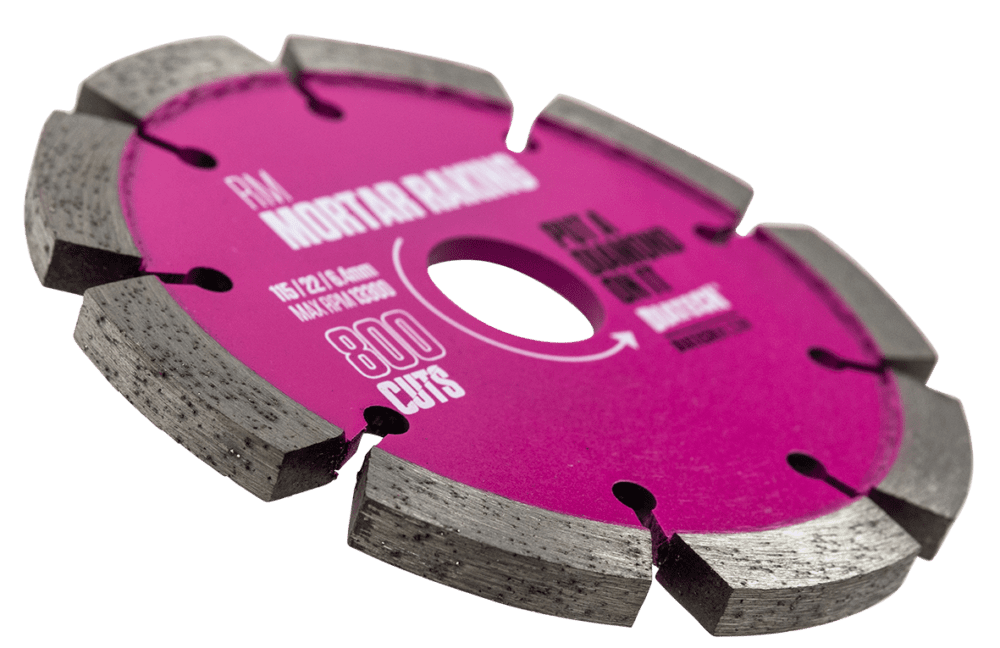
Rake Blade
In order to rake the joints of an eighteen square foot home, I would have needed a crew, and maybe multiple grinders and the ready supply of blades and bits to maintain momentum while the clock ticked. In 2000, I was new to Coastal South Carolina. I didn’t have folks to lend me tools, and I had no friends, family, buds, or former teammates to pitch in and help. I was a one-man team and raking the lengths of my WMJs was a job best suited for a squad. And no matter how I tried to plan it out, the bottom-line kept coming out intimidatingly pricey, even when I used super conservative guesstimates.

I should have been more appreciative of the suggestion, since it ultimately forced me to think it all out and then arrive at the right course of action for me on this project house, which was Chipping Off Weeping Mortar (coming soon).

Monday, July 20, 2026

Moving Beyond Weeping Mortar

I know what it’s like to own a home with weeping mortar joints. Furthermore, I get how it feels to have neighbors and visitors who are less than enthusiastic about this look. Not only can this sort of façade be polarizing, but time can also make it an issue homeowners feel compelled to address, especially after hearing people groan, say, “Ew! Yuck!”, or even ask with genuine sincerity, “What do you think they were trying to do here?” as they stare at your solidified ooze.

In my previous post I explained how someone might consider Embracing Weeping Mortar. But here, I’ll introduce two other options.

I suspect that the group of renovators who can say, “I want to grind out or chip off all the joints of my brick house!” is a small club. And it would be wonderful to imagine the possibility of waving a magic wand and having your sloppy joints disappear. But real-life solutions beyond sorcery do exist.  

Let’s say that you’re like I was, finding yourself in a situation where you feel as if you absolutely must deal with a weeping mortar situation. Besides mine—a painted brick house where the uniqueness of this style has been eclipsed—I can think of another circumstance that would make this condition tougher to ignore much of these joints being damaged badly.

Perhaps over time, a multitude of chunks have been victimized by Mother Nature and her weaponized freezing and thawing. Or maybe someone started yanking off invasive vines, and in doing so they accidentally broke off large sections of the weeping mortar.

What now?

If these joints have been damaged, I supposed there are ways to repair or make these no-longer-uniform spots less noticeable. However, if the area(s) of concern is/are widespread, other measures may be taken. For one, grinding out the joints and replacing them with fresh mortar is one possibility. Or as I did, you can chip them off.

Certainly, I suppose there are ways of patching and repairing the damage. But there are two huge issues with this. First off: cost effectiveness. And secondly, a big question: Will the repair work end up being more noticeable that the damage looked before mitigation or corrective measures were taken? I believe this is highly likely.

Because of these practical considerations, I will go on to explore two other options in detail.

Grinding or Raking Weeping Mortar Joints – July 26, 2026

Chipping Off Weeping Mortar – Coming Soon

Monday, July 13, 2026

Embracing Weeping Mortar

The first home I ever bought and renovated had weeping mortar. And these joints were critical to my opportunity to buy this house because it made the home look unsightly. I believe they scared other potential buyers off, not because this style is distasteful, but because the brick ranch had been painted and it made the property uglier and seem more hopeless, or more of a daunting challenge, than it would have otherwise. 

Painted weeping mortar of Pig's Ear #1 

Over time, a theory formed on my part that previous owners had ultimately decided to paint the façade after a master suite was added. Matching brick can prove to be trickier than one might imagine, and my deductive speculating has grown to presume that the old and new brick weren’t alike enough. In my Sherlock Holmes of renovation mysteries mind, the paint job established uniformity that resolved this elementary dilemma.  

This experience made me into a fan of weeping mortar, as long as it’s not been coated in paint. And since then, I can be cruising through some unfamiliar neighborhood, and this unique exterior coursework style will grab my attention. And I truly appreciate it for the aesthetic statement it makes.  

Although I am no bricklayer, I have laid a few pallets worth of brick and block over the years. And not only have I been the mason, I’ve also been the person buying materials and the tender mixing up the mortar. So first off, I am aware of the extra time and money it takes to pull off an entire house that showcases these oozing joints. And I can only imagine how much waste and extra clean up this adds to a project.

Still, when the work is finished and colors and textures contrast, it can be striking. And that’s the look that is easy to embrace.

My most favorite example of these joints is when they’re coupled with rust colored brick. And this may just be me, but I’ve really been taken in by homes with white windows and trim that add some visual pop along with well-manicured ivy that has been permitted to creep up to the soffit.

Like the lawn and hedges that need regular attention, these green leaves and vines must be kept in check. But I think it’s worth the commitment and effort, because for me this condition on the right home, when carried out effectively and properly, makes a memorable and quite fetching impression.   

If you have weeping mortar, I hope my take might allow you to appreciate it even more than you did.  However, if you are looking for options to divorce yourself from these sloppy joints, I’ll post about potential remedies in posts that follow.  

Moving Beyond Weeping Mortar - July 13, 2026

Monday, July 6, 2026

Final Post of the Series - Response to TV Show Viewers: Post 71

Response to TV Show Viewers: Post 1 - January 23, 2026

Response to TV Show Viewers: Post 70 - July 3, 2026

Apologies from me have been long overdue. So many worked hard on my behalf making American Rehab Charleston and then Restoring Charleston. I wanted to do better, to be better, and was far too short-sited on the ways things would play out. As I’ve mentioned, despite how I may have appeared within each series, I am aware than I was out of my depth in these circumstances, and for that I am sorry, for both myself and others. The most recent posts were intended to recognize efforts of the key construction protagonists who made me look capable and competent throughout ARC and RC, as I was actually struggling to keep my head above water for most of this experience.

On the production side, diligence on the part of producers gave me a shine that only they were capable of doing. For example, at times, it seems as if they often had me wearing blue to make my eyes grab attention, perhaps distracting from my asymmetrical mug. They kept me focused by scripting much of what they needed me to say, and this took a toll on all of us. Remaining patient with me throughout could not have been easy. The teams of people that had come to record me in action were used to working with pros, some trained, others naturally gifted. Although I showed up, put in time as asked, I was just unable to deliver on camera as they needed.

There were many times when I would say something in a filming, almost as producer’s would have liked, only to have an auditory hiccup make what I’d said unacceptable. Maybe some people can just rewind and say what they’d just said over again verbatim. But I never got there. At least not as easily as most would have liked and my efforts led to a stuttering issue, something that I’d never had to deal with before. I’m not sure how this Porky Piggishness works. Maybe it was my brain and mouth in some sort of conflict over pressurized calls to speak with so many listening. I had bright moments, but the skips in speech increased over time. This oratory accessory was not permanent though, and eventually faded away sometime before the pandemic, as casually as it had waltzed in.

I’m mentioning this as a lead in to talking about my appreciation for the show producers. I still don’t hold much confidence in the dos and don’ts of the television industry. I felt like I did a lot more incorrect than I did right in working with them and I continue to be uncertain of many things, off camera and on. I do candidly have serious concerns that more than a few might see my doing this—mentioning names without role/contribution precision—as further examples of my flaws and unworthiness. However overblown this may be in my head, I am using it as an explanation for not mentioning the champions on the production side by name.

Enough of the pity party though.


Within my dive into TV, I felt the red-hot desire to hit home runs on camera for the teams around me. And through this, opinions were naturally formed about addictions taking root for those desperately trying to deliver for people supporting and pouring into them. However, other than high doses of caffeine, I am able to report that I remained drug free for the duration and aftermath of this TV foray. And there are those you will see this position as one more issue.

Regarding my verbal fumbling and stumbling on camera, that was pureness. No cue cards or teleprompters were used in the making of either series, not by this guy or anyone else, never in the three years. Producers and I ground it out painfully together, from the pilot to the final day of RC. No shade cast toward newscasters, SNLers, or others. I’m envious, wondering if I could have even pulled off using those sorts of aids.

I worked with at least four different production companies. And I’m still foggy about who worked for which, those serving as independent contractors, members of the interior design teams vs. production, and on and on. I will say that of the things we really needed going into making Restoring Charleston in 2016, the one addressed was the experience of the production crew that the network executives were able to surround me with. In lieu of reality show backgrounds, we had producers more seasoned in home renovating. Maybe not condemned houses, but highly applicable knowledge and that was critical in us all working together to meet the tight schedule requirements.

As I touched on in a previous post, settling in down on the region’s historic peninsula for three months is a major expense for anyone. But along with this, was the cost of time and the extra wear and tear this choice placed on the production team. Without traffic, St. George is an hour from Charleston. But coming and going Monday through Friday, getting vehicles from parking garages, etc. and then dealing with rush hour traffic equated to nearly three hours of stressful commute adding in to each long workday.

It must have been thrilling to stay downtown. And crews were troopers about any supplemental burden this created. However, it couldn’t have been easy. And as I mentioned before, I should have suggested they stay somewhere closer. Easier scoots back and forth on I-95, like coastal situations on Lake Marion, would have done the trick. Then they could have escaped each weekend to the Holy City for R&R. Budget wise, this would have been best. But being candid, I was oblivious to much of this until afterwards. That’s on me and another thing I have regrets over.  

In 2016, my imagined adversarial presence with producers seemed to evaporate and I was included more into the circle of collaboration. This was not just helpful to me, but it made the summer more enjoyable, and in my view, it led to greater productivity. Over the course of three months, I learned to really appreciate while simultaneously trust the producers. These days working and filming throughout Berchador and I am unable to say enough hearty things about this crew I still feel blessed to have gotten to work with. I may be wrong, but I think they’re the blend of a team that could pick up next week where we left off a decade ago, the production/construction combo working together on opposite ends of St. George through triple digit heat.

With this appreciation for the teamwork and natural comradery we developed, I am also wholeheartedly grateful for several crucial producers who looked out for me. They advised and mentored me discreetly, pulling me aside as needed, whispering in my ears like veteran teammates or wise older siblings. I listened and it was life altering advice I’ll likely never be able to appropriately repay them for. In some perilous ways, these strangers who’d quickly grown into confidants and friends, also served as my guardians, saving my family from what I came to realize would have likely been devastating missteps on my part. Although I would like to mention these folks, as much or more than the contractors, they very specifically advised me that their anonymity was paramount for their own careers. I see this as cloak and dagger means and methods of thoughtfulness. So, for them in particular, I’m obliged to write of my nonspecific gratitude. You know who you are and I am forever appreciative beyond my words.  

Throughout this experience, I had perhaps been too overly focused on the boatloads of positives. Many can say I was naïve and too trusting. And yet I survived. We survived. And the shows are still out there getting attention. Could it have been better? Clearly, yes. But could it have been worse? Absolutely.      

I caught a shooting star in one hand and then was pulled and pushed out of the path of an erratic rolling boulder. And for both of these, I’ll always be indebted.

FINAL POST OF SERIES

Friday, July 3, 2026

Josh, Chris, and Jason - Response to TV Show Viewers: Post 70

Response to TV Show Viewers: Post 1 - January 23, 2026

Response to TV Show Viewers: Post 70 - July 1, 2026  

The end of this response series is leaning heavily into the fond memories of those who made it possible.

My three-year experience was broken into parts, clearly focused on the periods of taping the home rehabs for each TV series. The bulk of filming the pilot episode took two weeks in March 2014, the three months of what producers called the five-episode pick-up happened in the first quarter of 2015, and we made Restoring Charleston summer 2016 with any planning and post-production work happening in between.    

American Rehab Charleston - 2015

As I described in my previous post, Bob Fleming, the general contractor brought in to help us make the first episode of American Rehab Charleston, was the inadequately recognized hero who got us started on our way. Although there were many factors to us moving through each step of this experience, I don’t see how we could have gotten through March 2014 without Bob.

For the 2015 filming, the dynamic duo of Josh Hofbauer and Jason Dandridge were the miracle workers making me look masterful.

Jason Dandridge filming Restoring Charleston
Jason’s talents mirrored much of Bob Fleming’s in how he commanded his troops. In addition, I believe he may have membership in some legion of carpentry wizards, wowing me with his fractional math on the fly, in his head, factoring in multiple floor heights fluidly, considering thresholds and the materials and layers of multiple additions. I’ve done this, but not near as effortlessly, needing to double and triple check my figuring, while backtracking and scratching my head throughout. I’d never worked with someone as capable as Jason in these critical scenarios.  

He and Josh were an impactful combo and it was easy to take their teamwork for granted.

From the start, Josh reminded me of someone I’d known for years, and we quickly fell into step together on site and while being filmed. He was juggling the list of scopes in his head at once, the work I normally did. He handled it admirably, with added pressure of producers pushing the breakneck schedule. And to make it all even more difficult, he and the trades were forced to stop working throughout each day so I could stumble through multiple takes for the camera as they waited motionless and quiet out of view. I don’t know how Josh or any of them managed or how they truly felt. I imagine it would be like driving a car in heavy traffic while you’re trying to wolf down lunch, frequently being directed to pull off to the side, shutting down the engine, checking your phone, cranking back up, as you react to each whim and seemingly urgent need of a variety of production crew members.  
Josh Hofbauer

I think the majority of the guys were so proficient at their work, that they thrived on weaving their way through the extra wrinkles of the production schedules and activity. They plodded without big reactions, as if they privately knew the experience made them even better and gave them entertaining stories to tell down the line someday.

But speaking for them, they couldn’t have all been okay with me taking credit for what they did. No way. And I do understand that and am sorry I was unable to take more of a stand in this regard. Not only would it have been the best way to go, as I’ve said before, I think authentic appreciation on camera, intertwined into each episode, would have made both series better and more helpful for viewers trying to learn.   


By the time we started filming Restoring Charleston, Josh had returned to Michigan. But Jason lived with his family in the Upper Dorchester part of the county, and I was thankful he was willing to put off his other projects and focus on the Appleby House. With ARC under his belt, Jason had a solid sense of what the producers were doing and needed from him. He knew what he and his crew could do late at night, after everyone had gone home, and what must wait until regular hours when the producers and I had returned. The value of this aptitude is difficult to explain, but his experience in this regard had a sizable impact and the achievement of what many had told us was impossible: renovating both homes in nine weeks. Even more, he and his team did it with producers in the mix. A monumental accomplishment. This was not me. I was just a middle-aged cheerleader narrating his orchestration.  

Chris Brace
It was similar to Chris Brace remaking the cottage on the other side of town. And even though that house was smaller, this was a steeper mountain for the Brace Builders crew since they were rookies in TV rehabbing. To make this ride even wilder, they were an hour away from familiar territory and his shop. I’d only worked with Chris once before prior to this, in an easy role for me as a volunteer in his efforts transforming a house into a women/children’s shelter. Because of this tie, I knew what type of stellar work he did. And although I enjoyed working with Bob, Jason, and Josh, none of that fun was captured as effectively as the comradery producers found a way to feature with Chris and I getting down and dirty in episodes six through eight.

Like my feelings about Bob Fleming, it’s hard to imagine how I’d have gotten through this experience without the talents, skills, and efforts of Jason, Chris, and Josh.

Response to TV Show Viewers: Post 71 - July 3, 2026

Wednesday, July 1, 2026

Bob Fleming: Unsung Star of the Pilot - Response to TV Show Viewers: Post 69

Response to TV Show Viewers: Post 1 - January 23, 2026

Response to TV Show Viewers: Post 69

In the filming of American Rehab Charleston, producers needed a hero shot. I’m not a soldier or emergency person, so I had to be coached up by the showrunner who said, “You’re the hero here, Trent. You’re the one saving the house.” Restoring some property no one else seems to care about is hardly worthy of glorified status. But this person and their crew had been assigned to me and part of showing up required cooperation, a willingness on my part to go along with what they were trying to get done.

To be clear though, not only am I unheroic, but I also wasn’t even the driving force on these two weeks of work, certainly not like what I usually do on my projects. An executive producer was leading efforts to create the pilot, and this person had hired an amazing general contractor named Bob Fleming to oversee all the renovation activities over and around me. 

Bob Fleming
Classic Remodeling and Construction

It had all started with a programming director reaching out to me before I found, bought, and then redesign the home, I had dropped way down the list of truly significant. And on the surface, it looked like I was the guy. But below that, to anyone paying attention for a couple minutes, Bob was the true commander on my house project. And although I admired the depth of his experience, the respect his crews had for him, and the commitment he granted toward what was being done on the house I’d invested in, it didn’t feel great to be sidestepped.

With time, I could have done what he did for us. I wanted to. Except it would have taken me months. Producers only had two weeks, and he pulled it off seamlessly. As a compromise here, since they wanted and needed to bring in someone like Bob, I think it’d have been best for all if I’d just sung his praises on camera. Nothing over-the-top or grandiose, just honest acknowledgement that was deserving because Bob is a true contracting master, perhaps what I could have been, but heights I came up short in reaching.   

This use of the general contractor may shed some light on the differences between the production company and HGTV/DIY, something I’d unknowingly stepped into. And maybe the folks in New York thought I was hunky-dory on this circumstance. Again though, there’s so much I didn’t know about.

So even though I was the subject of focus for the hero shot in the intro and the series, the real Houdini of the pilot episode house project was Bob Fleming and Classic Remodeling and Construction

Response to TV Show Viewers: Post 70 - Coming Soon   

Monday, June 29, 2026

Claiming Undeserved Credit is Awfully Unpleasant - Response to TV Show Viewers: Post 68

Response to TV Show Viewers: Post 1 - January 23, 2026

Response to TV Show Viewers: Post 67  - June 26, 2026 

Early into my TV phase, filming a scene for American Rehab Charleston, the showrunner pulled me aside, and delicately said, “You need to stop saying 'we'.” As previously described, off camera was an army of tradespeople and designers and producers working hard each day for months.

Something that felt normal throughout this experience was that in the grand plan, beginning to end, the rehabs were a large team effort. Of course, having a deluge of people all at once instead of a daily trickle was a big adjustment. But having involvement from plenty of others in the middle is common on most of my projects.

What had made it feel somewhat typical were these usuals, beginning to end. I’d measured up the house after becoming the owner. Then I reworked it on paper before planning out how to take it on, with much of this thinking going on organically as I cleaned out and organized anything left behind.  

Throughout filming I began to understand all of the parts and scopes of the project that would be excluded. And this allowed me to get a handle on the finishing and buttoning up of loose ends after everyone else left. Overseeing the last leg until I sold also felt like familiar territory, a pattern all my project houses shared.  

As always, I was solidly tuned in to what help I'd need to restore the property completely, but since I narrated the project and progress on camera, my actual role was diminished substantially, even more than I’d expected or realized going in. And since I was doing so much less than usual, I considered saying “we” as a compromise, a stretch on what I felt was normal and what was truly going on around me each day or off and away filming off site.  

Back to this moment of directions from the showrunner. After laying out my points, making it clear how I felt more comfortable using we, this producer explained it in a way that was close to something like, “I hear what you’re saying, but you’re the only one on camera. Viewers aren’t going to see anyone else. So, you need to try harder to say, ‘I’ and ‘me’ instead of ‘we’ and ‘us’.”

In my view, giving deserved credit was not just the right thing to do, in a business sense it was prudent. As I fully understood, genuine appreciation, recognition, and acknowledgement inspires people. Giving due credit was another form of payoff; currency paid out to the skilled craftspeople we desperately needed. It was the sort of thing that fueled the necessary willingness to keep grinding.

In the back of her mind, I think the producer understood this and she astutely added, “It’s okay. Everyone gets it. They understand what we’re doing here.”

With effort, I got better at all of this, but it was a private, unappetizing battle. I’m not sure which was worse, the moment I accepted credit and had it recorded, or watching these scenes play out on the television screen months later.

The thing is, everyone is an absolute. And since there were dozens of people impacted, it was an overgeneralized embellishment. Everyone didn’t get it and I couldn’t blame them. Who wants some home rehabbing blogger in spic and span clothes accepting their deserved glory? Who would want to watch a show with their families where I’m being celebrated for their efforts after months of coming in early or staying late, missing time with them, friends, and neighbors?

The producers weren’t contractors. They sincerely didn’t understand what they were asking or how it might have made the tradespeople feel. I did and I should have worked harder until the TV creators understood.

To me, going along with this credit taking approach was just another misstep on my part. I suppose I was trying too hard to accommodate producers. It was such an amazing opportunity, and I didn’t want to seem difficult, as if the break had gone to my head or that I was ungrateful. This expectation was just another beyond my navigational skill level.

This serves as another example of my failed leadership. I could have called a meeting with the producers, maybe even brought the contractors in. This sort of air-clearing heart-to-heart would have gone a long way to ease heartburn. And it would have paid dividends the production company was unable to understand but benefits they surely would have felt.

In my opinion, with no TV experience backing it up, it would have been better if I’d done the normal thing on camera: pointed out how the tradespeople had come through for all of us. Just the normal attitude as a customary way of thanking them for their parts.

And just because those on the construction side were getting paid, that didn’t lessen the sting of me getting all the acknowledgment. Financial compensation is not a legitimate bandage, not when someone like me knows better, or should have been in a better position to do right by those with the utilized skills and talents.

As I’ve steadily admitted, I didn’t know television. But my career in construction and renovating meant something. Other than HVAC work, I’ve done most of the other trades and scopes at least once. And except for plumbing and electrical, they’ve been solo missions. But that didn’t qualify me to be recorded as if I was the site superhero with all the answers. Part of the fun of each project is learning, growing as a renovator, and adding onto my own cache of knowledge and skills.

What I’m trying to make clear is that not “everyone” got it because that’s not how it was. And believing something like this is nonsensical. Producers expect to be mentioned within a production’s end credits. Contractors deserve appreciation as well and my part, even though I was being cooperative, is/was the opposite of this gratitude, what is a vitally important ingredient in any construction effort when it’s genuine.

Response to TV Show Viewers: Post 69 - June 31, 2026  

Friday, June 26, 2026

The Gray-Haired Golden Rule - Response to TV Show Viewers: Post 67

Response to TV Show Viewers: Post 1 - January 23, 2026

Response to TV Show Viewers: Post 66 - June 24, 2026

The start of this blog in 2011, aimed for something of a how-to tone, sharing advice and writing the steps to help aspiring DIYers progress through their own rehabs. Yet with the reflective storytelling, it’s understandable how some may consider it memoirish or a hybrid how-to/memoir. And this whole series is closer to the second of the two genres.

This post is more than a response to questions or comments. It’s backstory worth sharing as I conclude with cheerful memories making Restoring Charleston.


The Golden Rule is a universal beacon for civility: treat others the way you want to be treated. The Gray-Haired Golden Rule, is this guidance with a twist: treat seniors as you’d want someone to treat your own grandparents. And if you don’t have solid relationships with your elders, Lord watch out for the silver headed nearby.

In 1994, I moved into a Cincinnati apartment managed by a widow who was spread thin and beginning to fray. Oversights and reasonable lapses led tenants of this twenty-unit building to move out. However, I stayed. And by year’s end, it was down to just us in this three-story brick in Hyde Park.

Rather than virtuousness, my hanging in there was rooted in my grandparents and this landlady reminding me of them. Perhaps it was because her life had mirrored theirs—the Great Depression, Pearl Harbor leading to WWII, followed by the post-war boom, space race, and the seventies. For the lack of a better way of describing it, what loomed was some hazy obligation to help her as I would want someone to be there for my own elderly relatives.

After becoming disoriented out and about in the Queen City, this childless woman found herself at The Christ Hospital. She had no family in the area, and it had taken me two weeks to figure out where she was. Due to cautionary abundance wrapped in legal reasons beyond me, TCH staff was obligated to detain her.

It eventually became clearer how this would culminate in her becoming a ward of the state, whatever that may have meant. After I tiptoed around this news, she revealed how she was well aware. “I know what they’re saying, young man,” was her reply.   

Mrs. Drollinger never said my name, and young man registered with my ears like an accepted nickname that she used at her convenience.

She understood the future she might be faced with but wasn’t having it. Even though it appeared as if her fate was sealed, she then set me straight as she grabbed a phone and opened up the yellow pages. “Where there’s a will there’s a way,” she said before adding, “And I’m getting out of here.”

Then against some tall odds this detainee proved the hospital know-it-alls wrong and found a way to be discharged.

Five years later, after buying a condemned house that I was determined to rehabilitate, inspiration was drawn from this triumphant pathfinder from my past. And when construction authorities explained how bringing on a full-time GC was paramount, her words echoed in my head. When some said the smoke smell was unconquerable, I remembered her resolve. When the twelve-month schedule was deemed inadequate, I reminded myself that “where there’s a will there’s a way.”

And just like how it worked out with the hospital forecasters, the construction expert’s pre-determinations were sidestepped.

What would eventually inspire me to find a way of reconnecting her with distant family living in Oklahoma, was an oven fire in her apartment. My first attempts to put it out with my pintsized extinguisher didn’t work and the 9-11 operator dispatched the emergency brigade. Then, after persuading this septuagenarian to step outside, the army of responders flooded Linshaw Court as we walked out the front entrance.  

Although the flames had been snuffed out—the third time had been the charm for my extinguisher—they’d come prepared for the worst. Besides the hook and ladder truck, there was the fire chief, an ambulance, and a couple other red vehicles.

The building’s owner was genuinely amazed. And naturally, passively, she simply asked to herself more than me, yet aloud, “Is all this for me?”    


We were just into the first summer week of 2016 and I was filled with intense excitement, nervousness, and a healthy anxiety that would keep me necessarily focused until the circumstances wrapped in August. The production phase, the process of filming the projects for Restoring Charleston, had begun in the small southern town of St. George.

The Appleby House sat on the edge of town and had been vacant for fifty years before being condemned by local building officials. At least, that’s what I’d been told and everything pointed to this being true. Following an invitation to have a look, I took a chance and became the owner. The windows and doors were still partially boarded up, and I was likely a schoolboy the last time the wood siding or trim had been painted.

Appleby - Before

After thorough reviews, I felt at ease about structural integrity. It looked decidedly worse than it actually was, my type of project house for sure and ideal for a TV rehab.

Built circa 1895, this home had been crafted by skilled tradesmen of its era, surviving over a century of scorching summers and countless hurricanes while racking up more years than anyone still alive. It was laced with artful interior trim, mantels, and doors that were salvageable, with heart pine floors to accompany bead board walls and ceilings.

Occupied by spiders, dead rodents, and one mummified cat, it was a prime candidate for generating Halloween season unease. Although some locals were convinced that this place was inhabited by ghosts, I’d been all through the home, alone multiple times with only a flashlight keeping me company. I felt no creepy vibes nor heard any questionable noises. Nothing had given me serious pause.

In the early days of getting up to speed with the task at hand, producers had been overheard speculating on Appleby as the most challenging rehab effort in the network’s history. This may have been a stretch, but still, it made me feel good, this possibility of being placed atop this unofficial mountaintop.

Coupled with my faith, what allowed me to be worry-free in that moment, was my confidence in the pros mobilizing around me. But being straightforward, fair to myself, I’d taken on more awful with much less help. It was simply a great old home, with palpable potential, and too special to ignore. By way of the pictures I’d taken and emailed, the producers in New York and Los Angeles had fallen for it too.


In this first week, the site was humming with grips and assistants busy setting up cameras and equipment. There were production crews staffed by people from all over the country, along with dozens of local contractors, tradespeople, and an interior design team. A production trailer had landed in a back corner of this parcel, strategically placed to be out of site throughout filming. A large storage container for equipment, supplies, fixtures, and materials was behind the office box. Dumpsters, work trucks, and trailers filled the fringes of our lot. The planted cotton field directly behind us was off-limits, but vehicles had spilled over into the vacant area across the street. Icing on this cake was an air-conditioned restroom trailer—one side for women, the other for men—tucked within an enormous cluster of towering azaleas. In three decades, I had no memory of any jobsite perk topping this.

In addition, were the two other houses on the opposite side of town. This St. Geo trio had been acquired to revive this summer, yet we were only rehabbing and filming two of these three simultaneously. Without a doubt, it would be my greatest professional challenge yet. The third home had been placed on the back burner. Along with apologies, were network assurances of them returning next year to be part of its rebirth.

This bustling scene was radically different from my first pig’s ears in the early years of the new millennium. Suddenly, from some dusty corner of my mind, a question leaked out, “Is all this for me?”

More than a case of me hearing voices, it was a spewed memory in the form of a rhetorical question. Insinuations of unworthiness were absent here, with me willing to believe that travels on the road to this point had made me deserving.

Then this internal monologue was interrupted. The sound of cheerleaders practicing on the other side of the street busted through the usual cacophony of jobsite activity—barking and banter, tools banging, equipment revving. These peppy teenagers were likely hoping to witness some filming or perhaps even get captured on camera.

The atmosphere was circus-like.

“Is all this for me?” Those were the words spoken by my landlady years back as we emerged from the smoke-filled building as vehicles of the rescue fleet took positions in front of our near-empty building.

Now, it was as if she was pridefully haunting me, like a fifth grandparent.

Mrs. Drollinger had been amazed then, just as I was in that moment looking over the energized scene. It was radically unlike my history of solitude on desolate house projects in my rearview, years of long days spent alone, thinking things through by myself. I knew that with all the support, the upcoming months would be comparably different than those early unwanted home restorations; teams and crews tackling the lion’s shares of the work as production assistants brought me coffee, offered water, or took my lunch order each day in between direction and questions with cameras recording.

Appleby - After

I was filled with awe and appreciation, imagining five satisfied faces sitting in the bleachers of heaven, giving me an extra reason to smile as I put forth my best efforts to deliver for producers.

Was all that for me?

My people would answer yes.

Response to TV Show Viewers: Post 68 - June 29, 2026

Wednesday, June 24, 2026

Queries Which Deserve Decent Answers - Response to TV Show Viewers: Post 66

Response to TV Show Viewers: Post 1 - January 23, 2026

Response to TV Show Viewers: Post 65 - June 22, 2026

It’s understandable for people to watch the show and then send notes with questions or pointed remarks:

“If you’re a historic restoration expert, then why would you do a, b, and c instead of x, y, and z?”

I can easily follow that sort of head scratching.  

“Why is the show called American Rehab Charleston instead of ‘American Rehab Summerville?’ Don’t you like Summerville? We think it’s wonderful. What’s your problem?”

“Why is the second one Restoring Charleston? St. George ain’t Charleston.”

That feedback also tracks.

I can apologize for the decisions, any confusion or discontent these choices have caused. I don’t have any hesitations over explaining how I’m not an expert as they’ve read, as I’m described throughout both series. I’ve never said that about myself nor did I talk this over with producers. Rather than calculated deception though, I think some on the production side see me in a more glorified posture than I deserve.

Also, even though I can try to shed some light on program creators using Charleston in the titles, it oftentimes seems to ring hollow, feel like it’s not enough, perhaps due to me not being part of the verdicts on show naming.

People have invested a lot of time watching the shows, sometimes all fourteen episodes more than once. Then they’ve found a way to reach out to me, thought out what they wanted to say or ask, and hit send. Ignoring them may seem optional, but I’m inclined to do something when I can. Now, I haven’t typically stepped in when people have vented online, but I’ve read enough comments to gauge opinions, and diverted those responses to this series.

In 2014, after committing to a four-episode series about my house project in Summerville, the production company downgraded this opportunity to one pilot episode with a chance for a full season. To the surprise of many, we were granted the unexpected, along with a two-episode bonus. Even more shocking, was that ARC rated well enough for us to earn a chance to keep going, to renovate three more houses with film crews in 2016.      

Although an actual series being shown occasionally on DIY and a verbal agreement to do more was wonderful, it had not been enough to secure the financing I needed to buy three houses in Charleston. Perhaps my appeals to producers for necessary steps went unrealized because it was the end of the year, the holiday season, and decision makers in New York were focused on more important projects.  

Without a valid written commitment, or perhaps a letter of intent, financing for the three houses on the historic peninsula, what it seemed like everyone, including me, really wanted, were out of my financial reach. Even though I was willing to take chances that hinged on over-the-phone directives, bank officials had boxes that needed checked, and written specifics was early in the approval process.

Their preliminary questions were basic:

“What if the producers don’t actually come back?”

“What if they decide not to do all three houses?”

“What if they put you off for a year, like they did before?”

This seven-figure financing, my efforts to form the short-term partnership with lenders, was another test and I did not score high marks. Getting written details from the networks was not an outlandish request. And yet I couldn’t get that done. Not only did my willingness to move forward without a contract make the arrangement appear questionable, but it also made my professional judgement suspect.   

And still, my faith more than solid business acumen, allowed me to roll the dice and tap into my own reserves.

After unsuccessful property searching in Summerville, I eventually found three of my sorts of houses—vacant/condemned/seemingly unwanted—in St. George, pig’s ears I could buy with a combination of cash and a negotiated agreement with one of the groups of sellers. Diann had seen the lights, cameras, and activity, and she was in my corner, unwavering. She wasn’t pushing me on yet was staunchly supportive in this gamble.

But then, bank official’s concerns became a reality: the network cut our episodes from twelve to eight and three houses down to two. Although this was still an amazing blessing, it was unfortunate. Even though I extended my trust to Team Scripps, the financiers had known not to, exemplifying why they were sentries of the safes with the money. It stood to reason, that besides not wanting me to default on loans, they likely were trained to avoid involvement with that sort of mis-stepping    

I hope this post goes further to answer curious questions of some viewers.

I can now see the runway approaching this series’ end. And I’ll be wrapping on a decidedly upbeat note, sharing fond memories of making Restoring Charleston.

Response to TV Show Viewers: Post 67 - June 26, 2026